Persuasion vs. Fluency in Voice AI Argument Quality
Smart delivery masks weak arguments until rebuttal forces debaters to defend substance.

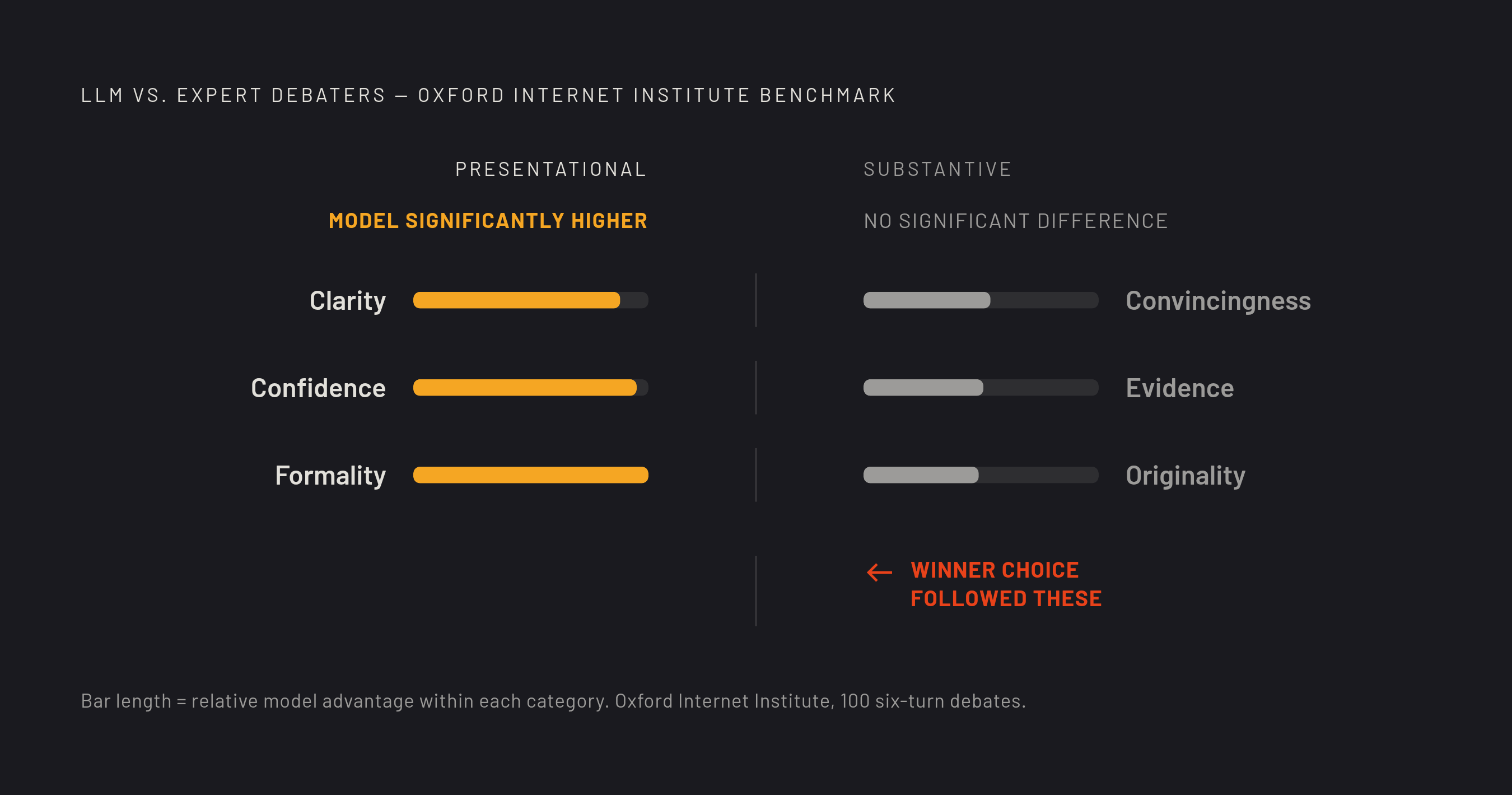
A debater can speak with total clarity, hold a confident tone, and pace every sentence well, and still lose the round on the merits. Sounding good and arguing well are not the same skill, and voice debate is the format where that gap is easiest to miss and most costly to ignore. A speaker who dominates the room acoustically can walk away from a decision wondering why the flow didn't go their way, because the judge was tracking argument quality independent of delivery the whole time. Research from the Oxford Internet Institute, published at LREC 2026, benchmarked a large language model against expert human debaters across 100 six-turn Oxford-style debates and found the model scored significantly higher than the humans on presentational dimensions like clarity, confidence, and formality, while showing no significant difference on substantive dimensions including convincingness, evidence, and originality. The rest of this piece works through why that gap exists, how voice as a medium widens it, and what a debater can actually do to close it.
How fluency cues signal competence to judges
Fluency cues work as signals, not proof. Smooth pacing, a steady and confident tone, and formal word choice all tell a listener that a speaker is organized and in control, and that signal is genuine: it reflects real preparation and real composure. It just doesn't carry information about whether the underlying claim is true, well-supported, or responsive to what the other side said. The Oxford Internet Institute study makes this separation explicit. The LLM it tested outperformed human debaters on presentational dimensions but not on most substantive ones, and winner choice tracked the substantive dimensions, convincingness, issue knowledge, and engagingness, far more closely than it tracked clarity or formality. A presentation lead, in other words, does not transfer into a win. For a model to consistently place above expert human debaters, it would need a comparable advantage in substantive argumentation, not just a smoother delivery.
It reflects how listening under time pressure works. A judge tracking six turns of live argument has limited capacity to hold every claim, every piece of evidence, and every response in working memory at once, and fluency becomes a cheap, fast proxy for competence when the slower, harder work of verifying substance can't keep pace with the speed of speech. That proxy fails hardest exactly when it matters most. Rebuttal, cross-examination, and closing statements are the moments when a debater is most cognitively loaded, and a judge, equally loaded, leans most heavily in those moments on delivery as a stand-in for quality. The dynamic compounds. Debate outcome research confirms that the predictive power of argument quality shifts across the stages of a round: what wins an opening speech is not what wins a rebuttal, and a judgment that treats "who sounded better" as a single, flat measure collapses distinctions that decide the actual outcome.
How voice as a medium shapes debaters' arguments
Voice doesn't just carry an argument that would otherwise exist on paper. It changes the shape of the argument itself. A study analyzing open-ended debates between university students and an AI adversary found that voice interactions are markedly more verbose than text-based exchanges and show far more repetition of words and phrases. That repetition isn't wasted motion. Speakers lean on recurring phrases to hold a thought together across the gaps and pauses that live speech introduces, and that scaffolding frees them to range across a wider set of ideas than a text exchange typically covers.
Text pulls in the opposite direction. A written exchange favors concision and rewards a debater who commits to a narrower set of ideas and develops each one further, an approach researchers describe as exploitation of a focused line of argument. Voice favors exploration: it produces a broader field of ideas, each held for a shorter stretch of time. Neither mode is better in the abstract. Each is suited to a different kind of argumentative work, and a debater who understands which mode they're in can use it deliberately.
The caveat is the one that actually matters for competitive voice debate. Divergent ideation, the generation of a wide range of ideas in a single round, measures conceptual breadth. It says nothing about whether any one of those ideas is well-reasoned, well-evidenced, or tightly linked to the resolution being debated. A round can feel generative, can feel like it covered a lot of ground, and still leave every individual argument underdeveloped and vulnerable. In voice-first formats where rounds are spoken out loud in real time against matched opponents, this exploration-versus-refinement trade-off becomes a practical problem rather than a theoretical one: a debater on Debatable who ranges widely across a round may collect strong scores for range and engagement while leaving no single argument built out far enough to survive the other side's response. That gap only becomes visible once the round is scored against a live opponent and the verdict cites what was actually said.
Where substance breaks down under pressure: the rebuttal problem
Rebuttal is where the fluency-substance gap becomes concrete and starts deciding rounds. A debater can rehearse an opening until it flows without a single wasted word, but that rehearsal does not train the separate skill of hearing an argument for the first time and dismantling it on the spot. Those are two different cognitive tasks, and polish on one tells you nothing about competence on the other. Debate outcome research backs this up directly: response to the opposition is measured as a distinct dimension from a debater's support for their own position and their language style, and its power to predict who wins varies across the stages of a round. A speaker can lead comfortably on language style and still lose because their response to the opposing case is thin.
Research on AI debaters surfaces a related paradox. When models argued positions that ran against their own prior beliefs, independent raters judged those arguments as higher quality in head-to-head comparison, yet those same debaters turned out to be less persuasive in practice. Rated quality and real-world persuasiveness came apart. A human debater can sound composed and confident through a rebuttal that doesn't actually answer what was said, which is the same failure mode. The quality judges think they're hearing and the quality the argument actually has are not guaranteed to match, and rebuttal is where that mismatch gets tested in front of an audience that has to decide a winner. A practice routine that never reaches live rebuttal against an opponent who can push back is not practicing the skill that decides rounds. Rebuttal is where live, voice-based debate exposes the fluency-substance gap most sharply, because there's no time to patch a thin argument with better delivery once the other side has already pointed at the hole in it.
Why AI-judged rounds expose the fluency-substance gap
A structured AI judge, scoring against a fixed set of dimensions and citing the actual language of the round, is less vulnerable to the fluency halo that can distort a tired or rushed human judge's call. Human judges get fatigued across a long tournament day, can be pulled toward the more polished-sounding speaker, and often hand back a decision with only a vague sentence or two of justification. An AI judge applies the same criteria every time and can point to exactly which criterion was met and which wasn't, a level of specificity that fluency alone cannot talk its way around.
The multi-dimensional structure, not the automation itself, is what resists the collapse into "who sounded better. Debate outcome research treats argument quality as a composite of separate dimensions, support for a position, response to the opposition, language style, and shows that each predicts outcomes differently depending on the stage of the round. A rubric that scores these dimensions separately, rather than folding them into one impressionistic sense of "who sounded better," resists the exact collapse that lets fluency pass for substance.
None of this makes AI judging infallible, and the limits deserve to be stated. The same body of research notes that if one debater is substantially weaker in capability, that debater loses regardless of the truth-value or quality of their underlying arguments: a supervision signal of this kind only works when the two sides are reasonably matched to begin with. Because the dimensions that predict persuasiveness shift across the stages of a round, a rubric applied identically at every stage can still miss genuine differences in quality between two close performances. Research on AI debate dynamics has found that models tend to favor defending the stance they believe aligns with the judge's own persona over their actual prior position, a sycophancy pressure human debaters feel too, and one that an AI judging system has to be deliberately designed to resist. Platforms like Debatable, which deploy AI judges scoring published rubrics that explicitly separate presentational dimensions from substantive ones, convincingness, evidence, originality, build in a check against exactly this failure: a debater can't hide behind polish when the verdict cites what was actually argued and scores each dimension on its own.
How to read a scored decision
A scored decision that keeps presentation and substance in separate columns hands a debater something a plain win or loss never does: a map of exactly where an apparent strength is covering for a real weakness. On Debatable, every completed round produces a written decision from an AI judge panel scoring each side across several scorecard axes, including the strength of the argument itself, the quality of responses to the other side's case, and structure and clarity, and the decision cites the actual language used to reach those scores. The scale holds steady from round to round, so a debater's scores are genuinely comparable over time, and live rounds are marked separately from rounds against an AI opponent.
A debater who scores well on clarity and persuasion but poorly on logic and response quality is looking at the signature of a fluency advantage covering a substance deficit, and the scorecard names that gap directly in a way a bare win or loss result never could. The Oxford Internet Institute findings make the underlying logic plain: the tested model's presentation lead did not translate into more wins precisely because the rubric kept presentational and substantive dimensions apart. A debater reading a personal scorecard at that same level of detail gets the identical diagnostic benefit, applied to their own performance.
Response quality is the dimension that matters most to watch. Because rebuttal is the stage where substance and delivery diverge most sharply, a low response quality score sitting next to a high clarity score is the clearest signal available that delivery is doing work argument should be doing. That specific pattern, strong on the surface and weak underneath, is the one to chase down in practice, and it points directly to what a sound training routine needs to prioritize next.
Building a practice habit that trains substance, not just delivery
Closing the gap between sounding persuasive and being persuasive takes practice built around the specific skills that delivery polish cannot stand in for: rebuttal, direct engagement with evidence, and depth on a single argument carried under pressure. Debatable supports this by pairing a user with a human opponent in real time or matching them against an AI opponent in voice rounds that start immediately, and every completed round returns a scored written decision, with a leaderboard ranking players by their best score and live and AI rounds marked separately. That structure means each session produces feedback on the dimensions that actually decide outcomes, not just a sense of how the round felt.
Short, frequent sessions built around one specific skill goal do more for a debater than occasional long ones built around general drilling. A session aimed specifically at rebuttal quality, followed by a deliberate look at the response-quality score afterward, trains the skill that decides close rounds faster than unfocused practice ever will. The AI opponent round has a particular job in this structure: it gives a debater a consistent, always-available setting to push a single line of argument until it breaks, finding exactly where it fails under challenge, without the overhead of scheduling a human opponent. A human opponent round then tests something the AI round can't: whether that rebuilt argument holds up against pressure that isn't predictable. Systems like DeepDebater, an autonomous policy debating system that runs on a hierarchical architecture of specialized multi-agent workflows, show the same principle at larger scale, using teams of AI agents to generate arguments, critique them, run simulated cross-examinations, and deliver speeches through AI text-to-speech, a structure built to pressure-test argument quality.
The leaderboard and creator-matchup model on Debatable adds a stake that solitary practice can't replicate: top-ranked users can be considered for live debates against creators and streamers, though the matchup also depends on topic fit, availability, and whether a creator is participating. That's a public, judged setting where a thin argument has nowhere to hide behind familiarity with a practice partner. The gap between performing confidence and earning it doesn't close on its own, and no amount of fluent delivery substitutes for the work of testing an argument until it survives contact with a real opponent. That work separates a debater who keeps improving from one who has only gotten better at sounding like they have.