Argument Coherence Scoring Rubrics for Voice AI
AI judges need multiple models deliberating to score debate coherence reliably.

A debater can walk out of a round certain the case held together, only to hear a judge explain that it collapsed somewhere around the third rebuttal, because coherence is a property of the full arc of a round, built and dismantled across every turn a speaker takes. A constructive speech can be clean, a rebuttal can be sharp, a cross-examination answer can sound confident, and none of that guarantees that the sequence of claims holds together as one argument. The failures that actually sink a round, a thread dropped in the second speech and never picked back up, a concession made under questioning and then quietly ignored, a position that contradicts something said twelve minutes earlier, are invisible to anyone grading a single speech in isolation. They only become visible when someone, or something, is tracking the entire round at once. Voice adds a further complication that text-based debate formats don't have to contend with: audio quality, pacing, and transcription accuracy all sit upstream of any coherence judgment, so a corrupted or garbled transcript corrupts every score built on top of it before the question of reasoning even enters the picture. None of this is a peripheral technical detail to be solved quietly in the background. It is the central design challenge any AI judging system has to work through before a score can be trusted.
The three coherence signals a voice AI judging system scores across a full round
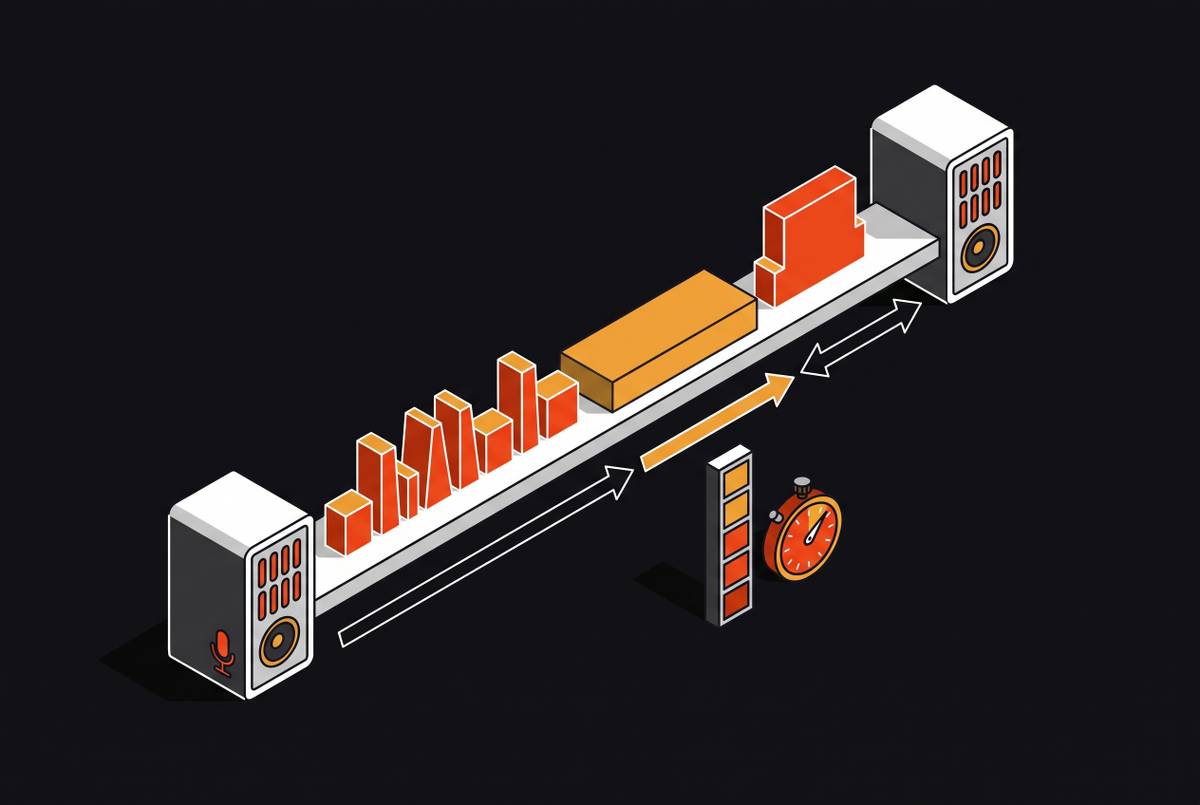
Production voice AI judging systems address this by tracking three distinct signals, each one built to catch a different kind of reasoning failure across turns, and each one blind to the failures the others catch.
The first is cross-turn consistency: whether a speaker's sequence of claims forms a single coherent thread across the round, with the system penalizing contradictions, dropped threads, and shifts in persona or tone that accumulate as the speeches go on. Picture a speaker who, in an early rebuttal, argues that a specific line item understates a budget's true cost, then in a later speech treats that same line item as already settled and uses it to support an unrelated claim about account balances. Each of those two moments, read on its own, sounds perfectly reasonable. A judge scoring only the later speech would hear nothing wrong. It's the pairing across turns that exposes the contradiction, and it's exactly the kind of failure a single-speech rubric is structurally incapable of catching.
The second signal is context retention: whether facts, positions, and concessions established early in the round are still known and respected later on. A debater who concedes a point under cross-examination and then argues in the next speech as though the concession never happened is not committing a logic error inside that speech. The speech may be internally sound.
The third signal weights failures by how badly they damage the argument rather than by how often they occur, producing an aggregate call-quality score across turns. A single catastrophic contradiction right before the summary speech does more damage to a case than a dozen small hedges scattered through the early constructive. This signal is what keeps the first two from being purely mechanical tallies. It asks not just whether a thread broke, but how much the break cost the argument.
Academic work on debate-specific assessment arrives at something structurally similar from a different direction. Peer-reviewed research frames a scoring rubric around three dimensions: Persuasiveness (how compelling and well-supported the argument is), Novelty (the originality of the angle and its avoidance of stock clichés), and Logical Coherence (the clarity, structure, and soundness of the logical deduction running through it). Each dimension is scored on a scale where the lowest scores mark poorly reasoned arguments, the middle of the range marks a standard argument, and the top of the scale marks something genuinely compelling and insightful. These three dimensions and the three coherence signals aren't the same framework, but they rhyme: both recognize that a score built from a single dimension, read at a single moment, misses the shape of the whole argument.
Why a single AI judge produces unreliable verdicts
Once a judging system commits to tracking coherence across an entire round, a new question follows immediately: can a single AI model be trusted to score it accurately. A single judge is too fragile a foundation for a verdict anyone should act on: independent models, asked to score the identical argument, land at meaningfully different places before any deliberation takes place.
A 2026 study on voice AI oral assessment measured exactly this gap. Without deliberation across multiple LLM judges, initial independent grading proved unreliable: on a 20-point scale, two leading models scored the same responses more than three points apart in a meaningful share of cases. After the models deliberated, that picture changed substantially. Near-perfect three-way agreement rose sharply, and the large spreads that had shown up before deliberation collapsed to a small fraction of cases.
The mechanism behind that shift is that deliberation is not averaging three scores together and calling the result fair. Each model has to defend its score to the other two, and that process exposes the specific cases where one model read the argument's structure differently than the others, either correcting the outlier or flagging a genuinely ambiguous moment for closer review. That is a meaningfully different process because it produces a reason for the final score, grounded in where judgments diverged and why.
The strongest objection to any AI-judged format is sequential and structural bias, and it deserves a direct answer. Research on AI debaters confirms that debate-style evaluation introduces a real structural advantage for whichever speaker goes second, and that models argue more persuasively when defending positions that align with their own prior training. If one model in a scoring council is substantially weaker or more biased than the others, that imbalance can quietly corrupt the whole supervision signal. Publishing the scoring rules before the round begins, rather than after it ends, constrains that bias. Doing so forces the rubric's criteria to stay fixed and prevents a model, or a human reading the model's output, from rationalizing a score after the fact to match a conclusion it had already reached. Multi-model council design is the structural requirement that makes a coherence score something a debater can actually trust.
How the rubric output reads
The score itself, a number out of 100 or out of 10 on each dimension, is the least useful part of what a rubric produces. The reasoning attached to that number is where a debater finds something they can actually act on.
Every rubric dimension generates both a score and a written explanation of why that score was assigned. A low coherence score paired with a reasoning note that identifies precisely where the thread was dropped functions as a coaching note, not merely a verdict handed down. Reading that reasoning well means knowing what to look for in each type of note. A cross-turn consistency failure names the specific turns where a contradiction appeared, telling the debater exactly where the rebuttal strategy broke down. A context retention failure flags the particular positions or concessions the speaker appeared to forget, which usually traces back to the speaker never having built an explicit internal map of what had already been argued in the round. An aggregate quality note often names the turn where the round was effectively lost, and that turn is rarely the final speech. It is frequently an earlier moment where a thread became unrecoverable and the rest of the round simply played out the consequences.
Rubric dimensions built for counterargument-specific assessment, categories like Focus, Logic, Content, Style, Correctness, and Reference, require this same kind of careful design because the underlying goal is to assess critical thinking, not general writing fluency. A debater reading a low score on Logic should find a reasoning note that identifies a specific inferential gap: a step in the argument that doesn't follow from the step before it. A vague complaint about clarity would tell the debater nothing worth fixing.
Reading a decision well is a skill of its own, and it's one most debaters never get to develop, because most judging has never produced output structured enough to practice reading. A written reasoning column attached to every score changes that. It gives the debater something to study between rounds, not just a result to accept or contest.
Coherence Signals in a Live Spoken Round
Knowing the names of the three signals is only useful once a debater can translate them into specific behavior, the things a speaker does or fails to do in real time that move each score up or down.
The cross-turn consistency signal rewards a speaker who explicitly links each new claim back to a prior one, using signposting that keeps the argument's thread visible to anyone tracking the case across several speeches. It also rewards direct engagement with an opponent's concessions, building new argument on top of what the opponent has already granted rather than arguing past it as though the round reset the moment a new speech began.
Context retention punishes a specific and common failure: arguing a position in a later speech that contradicts a concession made earlier under cross-examination. This is likely the single most frequent and most costly coherence failure in live rounds, because it is so easy to commit without noticing in the moment. The signal also punishes a subtler version of the same mistake, failing to incorporate an opponent's reframing of a premise and continuing to argue against the original version as though it were still on the table. Even when every individual claim in that later speech is logically sound, the chain as a whole breaks, because it is responding to an argument that no longer exists in the form being attacked.
The Novelty dimension introduces a different kind of pressure. Multi-agent debate research offers a useful caution here: when multiple agents or speakers debate each other, the dynamics of convergence can actively suppress the diversity of argumentation being produced. A debater who simply mirrors an opponent's framing to score points on consistency risks losing ground on novelty and persuasiveness, because the argument collapses into the opponent's own terms. Holding a thread together across turns and maintaining an independent angle on the resolution are both demands the rubric makes at once, and a debater has to satisfy both simultaneously, not trade one for the other.
Deliberate Practice Against a Scored AI Opponent
Once these three signals are understood, the whole structure of productive practice changes. The practice shifts from winning any single exchange to building an argument thread that survives the full arc of a round, concession to concession, rebuttal to rebuttal.
Research on AI-assisted learning points to a specific design principle that applies directly here: systems that give hints and structured feedback, rather than simply supplying direct answers, produce durable skill gains. Practice rounds where an AI opponent judges the argument and explains its verdict build real skill. Rounds where the AI simply argues on the debater's behalf do not, because they remove the exact friction that forces a debater to notice their own dropped threads.
That distinction shapes what a good practice habit actually looks like. Solo rounds against a voice AI opponent are valuable for repetition, for getting comfortable speaking at speed and under time pressure, but the scored verdict and its written reasoning are what convert those reps into measurable improvement. The coherence signals reward sustained engagement across multiple turns against a live opponent more than they reward rehearsing a single speech in isolation, so a useful practice format has to be interactive and scored, not a monologue delivered into a recorder. The habit that compounds over time is reading the reasoning column after every decision, not just checking the score and moving on.
Research on competitive debate programs backs up the premise that these skills are real and transferable, not merely academic. Schools where students take part in structured, judged debate rounds show measurable gains in reasoning and analytical performance, and the strongest effects turn up among lower-achieving students, particularly in programs serving low-income students and students of color. Quality debate practice used to require a well-funded team and an experienced human judge sitting in the room. A rubric-based AI judging system that publishes its scoring criteria before every round begins, and that produces a written decision citing what was actually said, makes that same quality of feedback available to any debater with a voice connection. Understanding the rubric this closely means learning what a coherent argument looks like from the outside, the hardest thing for any debater to see for themselves without a judge there to show them.
Sources
- Scalable and Personalized Oral Assessments Using Voice AI
- AI Debaters are More Persuasive when Arguing in Alignment with Their Own Beliefs
- Counterargument for Critical Thinking as Judged by AI and Humans
- PolyDebate: A Game-Orchestrated Multimodal System for Debate Skills Practice and Evaluation
- ArguAgent: AI-Supported Real-Time Grouping for Productive Argumentation in STEM Classrooms