Voice AI Performance Degradation Under Extended Round Length
Long voice conversations force AI systems to forget instructions and drift in tone.
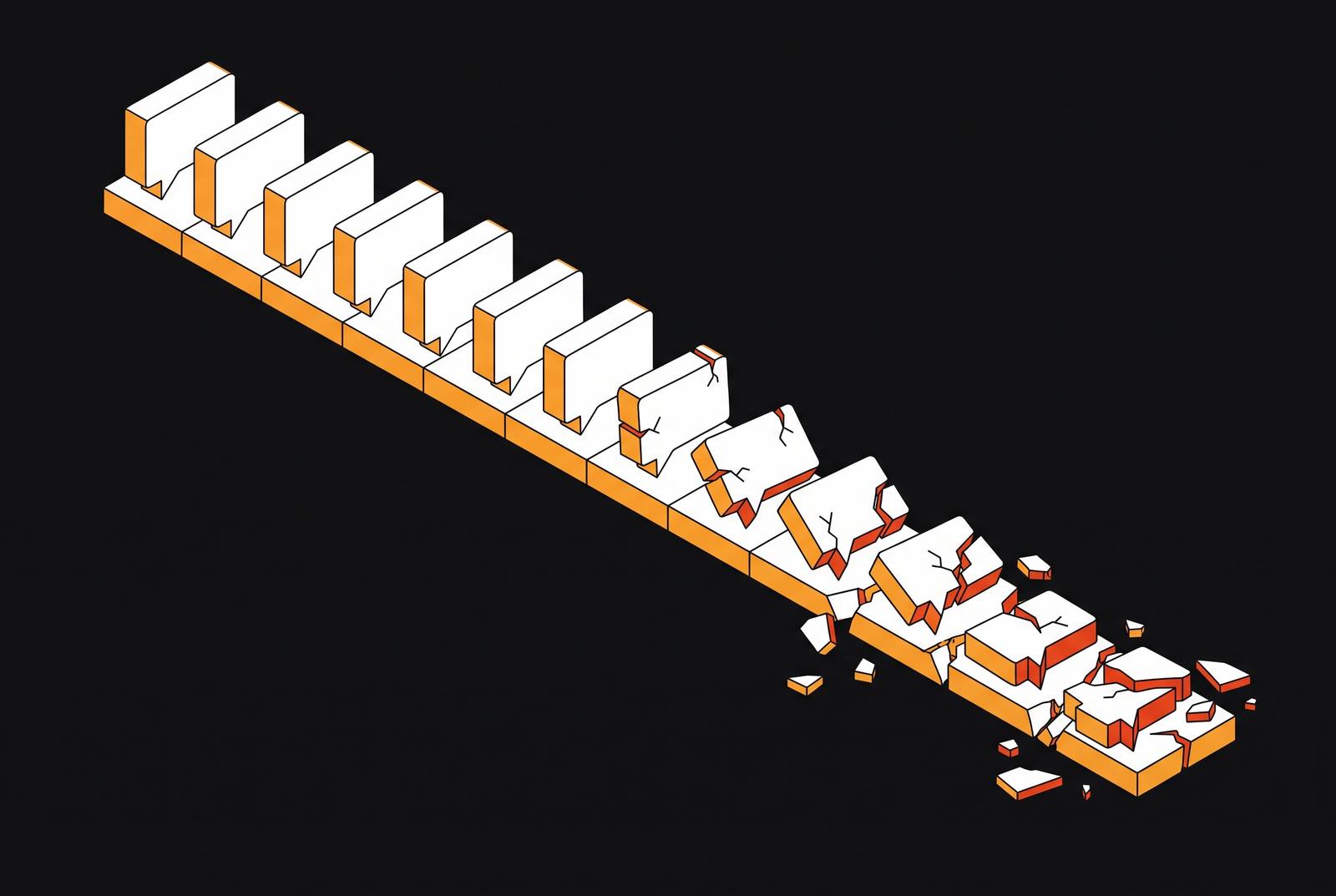
Voice AI systems degrade in extended conversations not through random failure but because of structural limits in how they track and apply instructions across turns. The degradation is measurable, predictable, and tied directly to turn count. For debaters and platform designers, understanding these failure modes changes what AI tools can reasonably be expected to do in a long round.
How voice AI systems process extended conversations — and where the problems begin
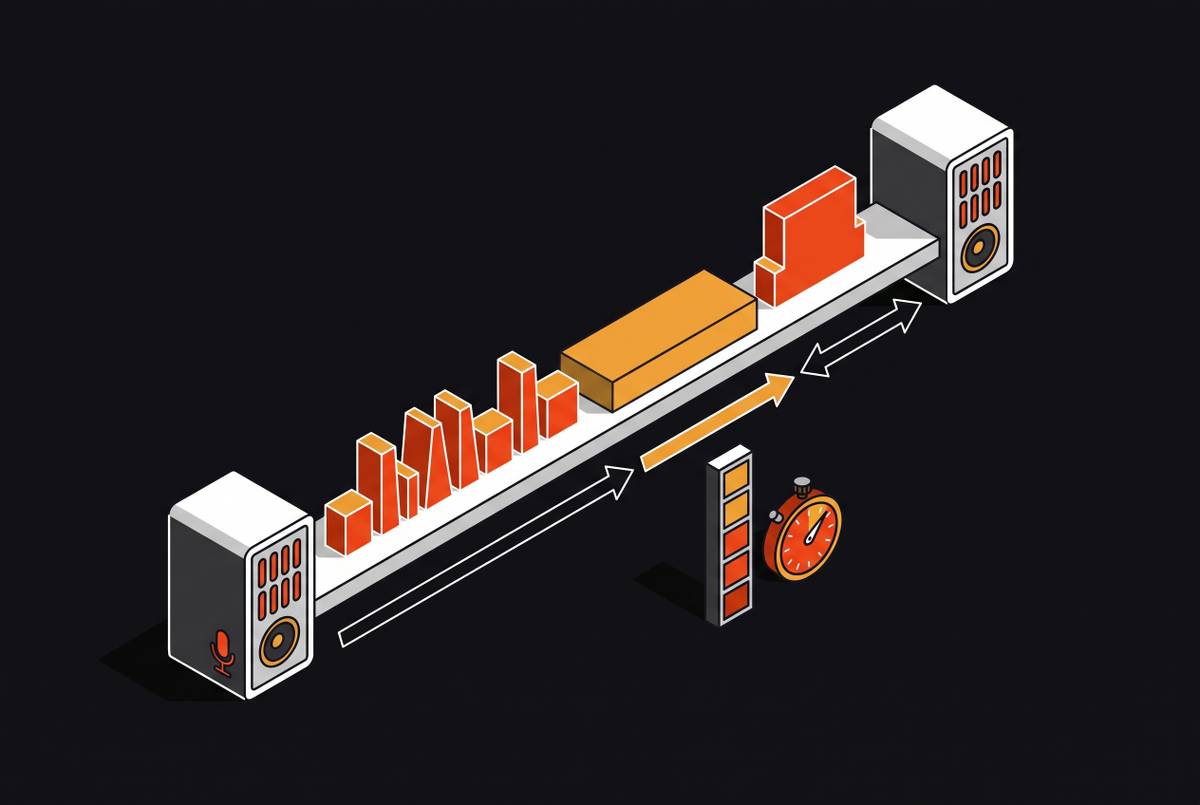
Two architectural paths dominate voice AI production today. Cascaded pipelines route speech through three stages in series: automatic speech recognition converts audio to text, a large language model generates a response, and text-to-speech synthesis renders that response back into audio. Speech-to-speech models collapse this chain into a single end-to-end system. Both approaches are common, and both suffer multi-turn degradation, though for different reasons.
Cascaded pipelines offer one clear advantage: each stage produces a trace, which makes debugging feasible when something goes wrong. But three models in series means three separate sources of delay, and the language model never receives paralinguistic signals that failed to survive transcription. A pause, a shift in volume, a sarcastic inflection, all of these are lost before the model ever sees the content. Speech-to-speech models reduce latency substantially, but the tradeoff lands elsewhere. Daily.co's voice AI guide notes that instruction following performance, flexible context management, and end-to-end monitoring are all weaker with speech-to-speech APIs.
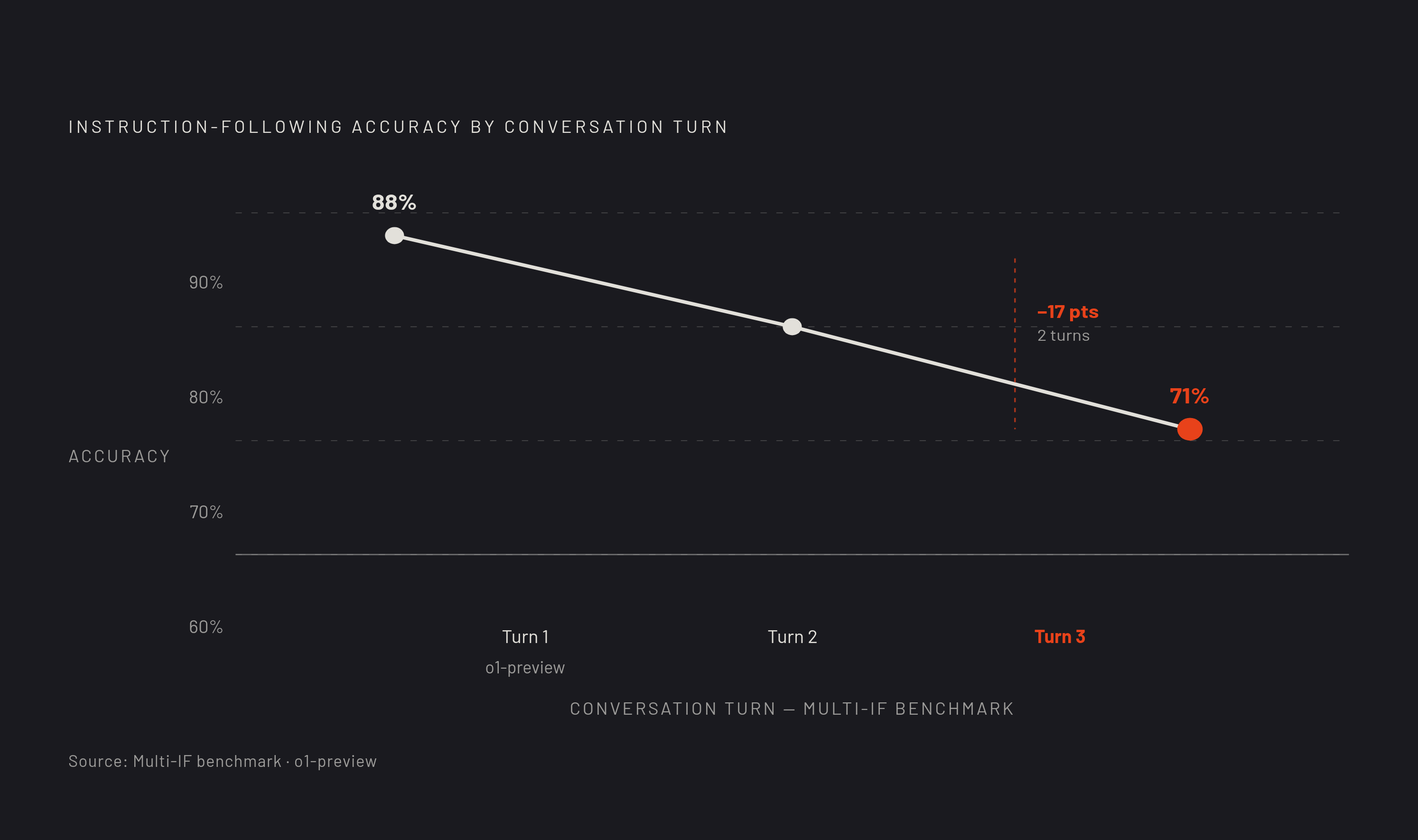
The deeper problem cuts across both architectures. Evaluation and development has been dominated by single-turn, fully-specified settings. Researchers benchmark a model by giving it one complete instruction and measuring how well it follows that instruction once. Multi-turn failure modes are poorly benchmarked and often invisible to the teams shipping these systems. Yet voice conversations are fundamentally long, multi-turn interactions, and that regime is massively underrepresented in training and evaluation data. The first turn of a multi-turn instruction following task sees strong performance, with models like o1-preview achieving 88% accuracy. What happens after that first turn is where the architecture begins to strain.
Instruction forgetting: how adherence to earlier turns erodes as conversation length grows
As a voice AI conversation extends, the model's ability to follow its own earlier instructions degrades monotonically. The decline is not random. It proceeds predictably and in proportion to turn depth. Each additional turn adds another layer of instruction history the model must track, and the model's grip on the earliest layers weakens as the stack grows.
He et al.'s Multi-IF benchmark documented this directly. Instruction adherence drops consistently across turns, a pattern the researchers characterize as instruction forgetting. Even the strongest model tested showed meaningful accuracy loss, dropping to just 71% accuracy by the third turn. This is not a flaw in one vendor's product. It appears across the field.
Laban et al.'s sharded simulation work adds a crucial dimension to the picture. Their experiments compared how models handle a complete instruction delivered all at once against the same instruction revealed gradually across turns. The multi-turn performance was substantially worse and far less reliable. The gap between single-turn and multi-turn formulations of the same task is large, which means the degradation is not about difficulty in the ordinary sense. It is about the format itself. Research on frontier models has also found that reliable conversational performance has a hard upper limit in turn count. That ceiling sits well within the range of a long competitive debate round.
Style amnesia: why voice-specific degradation is worse than text-only instruction forgetting
For spoken language models, instruction forgetting strikes something more than logical coherence. It hits the paralinguistic qualities that carry meaning in live speech: tone, emotion, accent, pacing, volume. These qualities are not decorative. In spoken debate, they are often what a judge or opponent attends to most closely, and they are irreplaceable.
Lin, Chiang, and Lee's style amnesia research, accepted to ACL Findings 2026, provides the primary evidence. They evaluated five models, three proprietary and two open-source, and none could maintain a consistent speaking style when instructed to do so from the conversation's opening. The styles tested included emotion, accent, volume, and speaking rate. Each is directly relevant to what a debate judge weighs. The most striking finding concerns what the models know versus what they produce. When asked in later turns to recall the style instruction, the models could recall it. They still failed to express it. The knowledge was present, but the output did not reflect it.
System messages complicate the problem further. System messages are specifically designed to provide persistent, conversation-level instructions. Yet they perform worse than user messages at sustaining style across a long session. The architectural feature meant to hold instructions stable is less effective than the ordinary conversational channel.
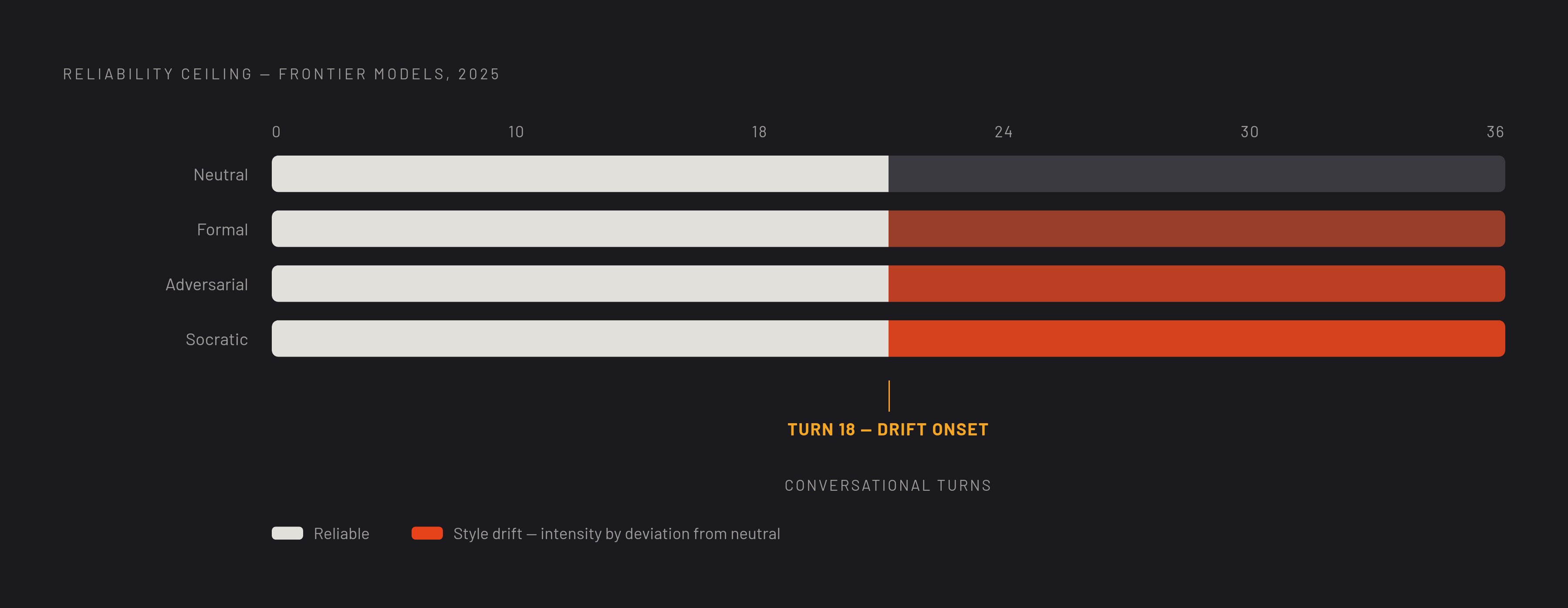
Models also exhibit a strong default bias toward neutral emotion and a single dominant accent. Styles that deviate furthest from this default suffer the most severe amnesia. An AI opponent or judge configured to maintain a formal, adversarial, or Socratic tone drifts toward a bland neutral over the course of a long round. The strongest 2025 frontier models sustain only around 18 reliable conversational turns before this drift takes hold. A partial mitigation exists: forcing the model to explicitly state its required style before each response, a recall process, substantially reduces the degradation rate. But it is a workaround, not a solution. It adds latency and depends on the system designer knowing the problem exists in the first place.
Latency compounding: how each additional speech turn adds friction that accumulates
Extended voice rounds face a compounding latency problem independent of instruction quality. Each turn adds pipeline delay, and the cumulative effect changes the feel of the exchange in ways that matter for debate practice. Latency is not simply a background annoyance. In extended rounds it becomes a structural barrier to coherent exchange.
Tool calls make the problem concrete. A database lookup or context retrieval roughly doubles LLM latency for any turn that requires one. In a debate context, any turn that requires the AI to retrieve prior argument history or concessions carries this penalty. The very act of checking what was said earlier, the mechanism that would help fight instruction forgetting, slows the response down. Every extra word the model produces adds another 50 to 150 milliseconds the caller has to wait.
The controllability-versus-latency tradeoff documented in Aissist.io's 2026 voice AI trend study describes the architectural choice between componentized pipelines and end-to-end speech-to-speech models. Componentized pipelines offer more control but more latency. Speech-to-speech models offer less latency but less control. This tradeoff does not specifically address the cost of mid-session context engineering to fight instruction forgetting, but the mitigations trade against each other. The work that would shore up instruction fidelity adds delay, and the work that would cut delay reduces the control needed to maintain fidelity.
What these failure modes mean for a debater using AI as a sparring partner or coach
A debater using an AI voice opponent or coach in a long round is not getting a consistent interlocutor. The AI that argued sharply in the opening exchanges is a different system, functionally, by the final rebuttal. Instruction forgetting means the AI may lose track of concessions it made or positions it established in earlier speeches. A debater who wins a point in round two may find the AI re-asserting the same position in round four, as if the exchange never happened. Style amnesia compounds the problem. An opponent set to be sharply adversarial becomes blandly agreeable. A judge configured for formal rigor becomes colloquial.
The skills that most require a sustained, coherent AI interlocutor are precisely the ones multi-turn degradation undermines. Research cited in FAU's AI-supported debate study found improvement in evidence use and organization with AI assistance. But rebuttal and counterargument scores, the skills requiring consistent back-and-forth, remained lower and less consistent. A 2026 study in Language Learning & Technology of EFL learners found significant gains in debating self-efficacy with AI assistance overall. Yet students rated AI as least helpful for oral delivery, which is the domain where voice style degradation is most acute.
The practical implication is not that AI sparring partners are useless. The issue is that their reliability has a turn-count ceiling. Debaters and coaches should set round lengths and expectations accordingly. Shorter, focused practice segments that target specific skills within the reliable turn range extract more consistent value than full-length rounds that push past the ceiling.
How AI judging handles extended rounds — and where it holds up versus where it doesn't
AI judging of extended debate rounds faces the same multi-turn coherence pressure as AI opponents. But well-designed multi-agent judge frameworks have structural properties that make them more resilient than single-model judging. The CourtEval structure documented in Kumar et al. 2025 uses four agents: a Controller, a Grader, a Critic, and a Defender 18. These agents challenge each other's assessments before a final score is issued. The arrangement mimics the multi-annotator human process and catches coherence failures that a lone judge would miss.
Research on AI debate for factuality assessment supports the value of this approach. Debate between AI advisors improves human and AI persona judge accuracy and calibration compared to single-consultant approaches, even when judges hold strong prior beliefs. Persona-conditioned LLM judges outperformed human judges and performed better than unconditioned models, which were statistically comparable to human judges.
The honest caveat is that AI judging systems are not inherently unbiased. They learn from training data, and if that data reflects societal biases, the system can perpetuate them. Well-designed systems aim to mitigate this but cannot claim complete elimination. Thank You For Judging's 2026 guide to AI-powered judging makes this point directly.
What autonomous AI debate systems reveal about the limits of long-form AI argumentation
The most complete autonomous AI debate systems operate under exactly the conditions where degradation is most acute. Their documented limitations are therefore instructive rather than incidental. DeepDebater is among the most complete AI debate agents confirmed in the research literature. It can generate a full affirmative case from a topic, construct a multi-pronged negative strategy, and execute an eight-speech debate including simulated cross-examinations. This is precisely the long, structured, multi-speech format where instruction forgetting, style amnesia, and latency compounding are most likely to manifest.
Recent research shows AI debaters are now rated as equally or more convincing than human opponents in live debates. Yet current systems struggle with planning effective arguments in the dynamic back-and-forth of competitive debate. The gap between what AI can do in structured, single-pass generation and what it can sustain across a live multi-turn exchange is exactly the gap the research throughout this piece has been measuring. A system that can write a strong opening case in isolation is not the same system that can maintain that case's logic, tone, and concession-tracking across eight speeches in real time.
How debaters and platform designers should set round lengths and judging expectations given these limits
Understanding these predictable failure modes gives debaters and platform designers a basis for setting round parameters that get the most out of AI tools while avoiding the regimes where they become unreliable. For debaters using AI practice tools, the guidance is practical. Treat AI sparring partners as reliable within a limited turn window. Use them for focused, skill-specific drills such as opening case construction, single-rebuttal exchanges, and evidence cross-examination rather than full-length rounds. When practicing oral delivery specifically, pacing, tone, and projecting conviction, AI voice partners are least reliable precisely because style amnesia degrades the paralinguistic feedback a debater depends on. This is the domain where a live human opponent is irreplaceable. Use the recall-prompting mitigation when available: explicitly restating the style or role instruction to the AI at the start of each exchange can substantially reduce drift. Track whether the AI is maintaining prior concessions and established positions. If it re-asserts a conceded point, that is a signal the session has exceeded the reliable turn range, not that the debater's argument was wrong.
For platform designers and debate program administrators, the implications are structural. Set AI-judged round lengths with the reliable turn ceiling in mind. Rounds designed to push into the fifteen-to-twenty-turn range should expect coherence degradation in both AI opponents and AI judges, and should build in human review accordingly. In-session context engineering, compressing and refocusing conversation history at defined points in the round, is the most documented mitigation for instruction forgetting at scale, per practitioner guidance from Anthropic and LangChain. Build it into the workflow rather than treating it as an optimization to add later. Transparency in judging design, including published scoring criteria, cited decisions, and human appeal, is not just an ethical choice but a practical response to coherence drift. When a judge's reasoning is auditable, drift is detectable and correctable. The latency-controllability tradeoff means that adding the context management needed to fight forgetting costs latency. Platform designers should measure this cost explicitly rather than assuming mitigations are free.
The failure modes of AI in extended rounds define exactly what a live, matched human opponent does not do. A human debater does not forget round two concessions by round four. A human judge does not drift toward a neutral tone over the course of a rebuttal speech. The ceiling on AI reliability is real and measurable. Knowing where it sits is what lets practice tools remain useful rather than misleading.