Human Escalation Paths as a Load-Bearing Test of AI Judge Confidence Calibration
Whether an AI judge's confidence means anything depends on what it does when uncertain.
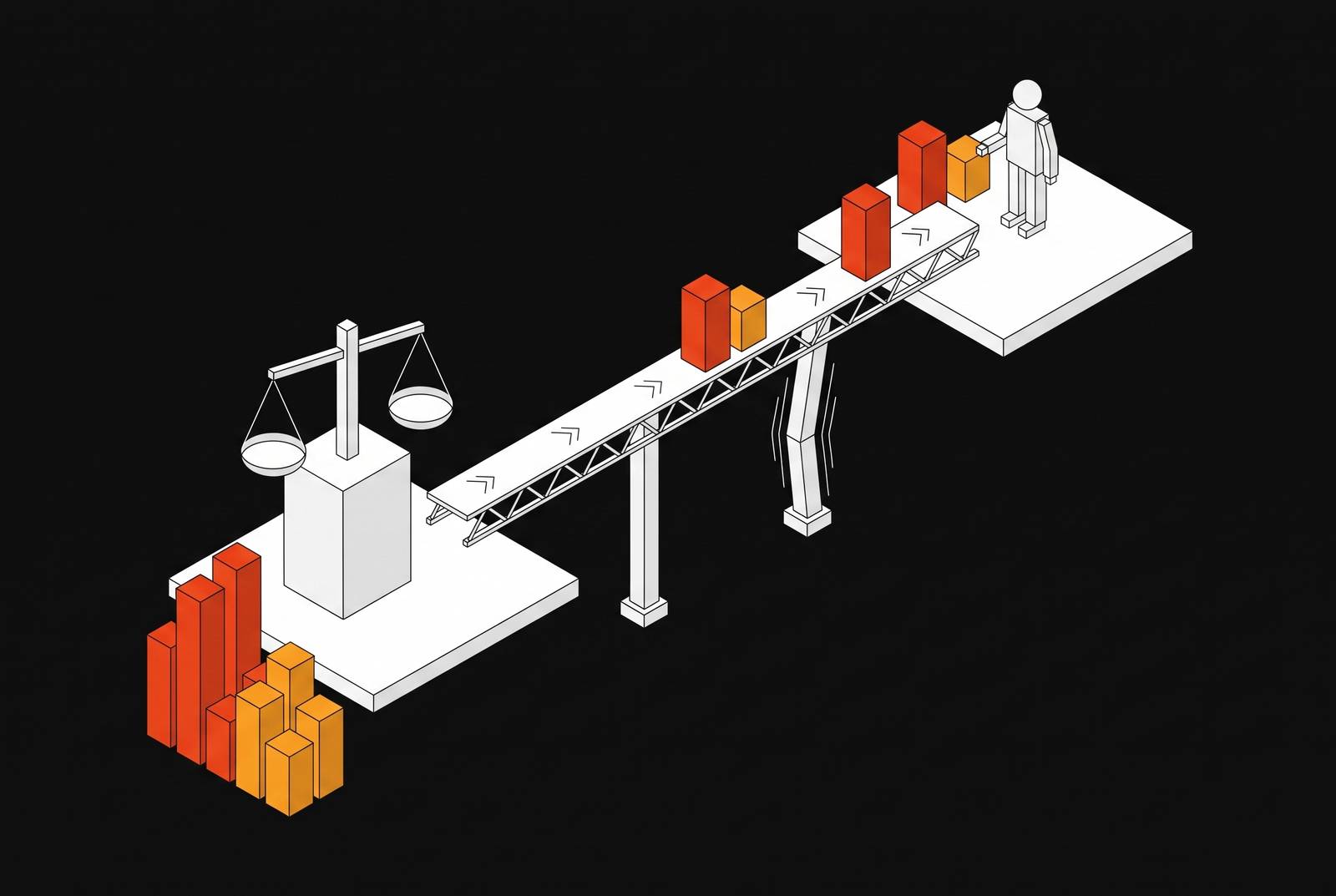
A live voice debate platform with AI judging and a published scoring rubric needs more than transparent scores to establish reliability. Human escalation paths provide the strongest test of whether a judge’s confidence tracks its accuracy. If uncertainty reliably sends genuinely difficult cases to human review, confidence has practical meaning. If it does not, the scoring apparatus offers a claim of reliability without the evidence needed to trust it.
Why an AI judge's confidence score is not self-evidently meaningful
The appeal of AI judging rests on consistency. The same rubric can apply every round, without fatigue or favoritism toward a charismatic speaker. But consistency is not accuracy, and a judge can apply a rule incorrectly while expressing equal certainty about every verdict. A confidence score is another output from the system whose judgment is under examination.
Jung et al.’s ICLR 2025 paper, Trust or Escalate: LLM Judges with Provable Guarantees for Human Agreement, identifies systematic biases and over-confidence even in strong judge models. Without a reliability guarantee, selecting the “strongest available” model substitutes a capability ranking for evidence about when its verdicts deserve trust. Assessing a judge’s confidence therefore requires asking whether it distinguishes dependable decisions from doubtful ones. The answer begins with what the system does when it is not sure.
What calibration actually means and why it is hard to achieve in adversarial settings
Calibration is the alignment between a model’s expressed confidence and the actual probability that it is correct. A well-calibrated judge’s higher-confidence decisions should be more dependable than its lower-confidence decisions. In adversarial debate, confidence is harder to keep in line with accuracy because the evidence changes from round to round as both sides try to win. The judge must update its confidence as the evidence changes. When the arguments on both sides seem equally strong, the judge should become more uncertain even as the speakers make their cases more forcefully.
The debaters began with average confidence well above the rational baseline, then became more confident through the closing rounds. Most revealingly, confidence still rose when models debated identical copies of themselves, despite being told explicitly that the rational win probability was even. That self-debate result rules out the simple explanation that each model thought it was facing a weaker opponent.
The finding concerns debaters. Its relevance is the behavioral warning it supplies. A model can hear arguments against its view and sound more certain without having better grounds for that certainty. The reported contrast with human confidence is equally important, since human confidence rises with accuracy while LLM confidence remains high and flat regardless of correctness. A judging system therefore needs more than a reasoned exchange to show that its confidence has become a guide to accuracy.
How human escalation paths are designed to be a calibration test
Selective evaluation gives uncertainty a consequence. Instead of accepting every verdict, the system assesses confidence and routes cases it cannot confidently judge elsewhere. This creates two sets of decisions that can be examined against human judgment, namely those the model accepts and those it declines. The distinction makes the confidence estimate falsifiable. A judge that labels cases uncertain must demonstrate that this label identifies a real limit in its ability to decide reliably.
Jung et al. formalize this relationship through a user-defined risk level and a specified level of agreement with human judgment. Their guarantee applies only to instances the model agrees to evaluate. That restriction is essential, not incidental. It keeps confidence in the decisions the model makes from looking like a promise about every case, including those it declines. It also separates a guarantee of human agreement from the broader claim that every accepted verdict is objectively correct.
Escalated cases that humans genuinely disagree on support the judgment that uncertainty was warranted, while routinely easy referrals indicate an overly conservative escalation policy. A system that never escalates provides no such evidence through its review path. Jung et al.’s Cascaded Selective Evaluation builds on this approach by starting with cheaper judges and moving to stronger models only when needed, while keeping the human-agreement guarantee. That model-to-model cascade is distinct from human review, but both depend on the same commitment to stop trusting a judge when confidence is insufficient.
What happens when escalation design is done well: the simulated annotators approach
The selection boundary is only as useful as the confidence estimate feeding it. Predictive probability and other existing confidence measures can overestimate human agreement, assigning high confidence to cases on which people would disagree. Such estimates obstruct escalation at its source. Even a clearly defined review process cannot help if the judge incorrectly classifies ambiguous cases as safe to decide. The system therefore needs to estimate uncertainty about human agreement, which takes more than measuring how strongly a model prefers its own answer.
Jung et al. introduce Simulated Annotators to address that problem through diverse annotator preferences generated with in-context learning. The method uses the agreement ratio between those simulations as a confidence proxy, with no need for external supervision. Its central idea is straightforward. Agreement across varied simulated preferences provides a different signal from the predictive probability of a single model response. It asks whether the proposed judgment survives variation in the preferences brought to the evaluation.
The method significantly improves both calibration and failure prediction while maintaining high coverage of evaluated instances. That combination is the concrete result to watch. Better failure prediction alone would be less useful if the system achieved it by declining nearly every case. The cascade result also shows that cost-effective models can contribute to reliable evaluation when their decisions are selectively trusted.
In this approach, good escalation is not synonymous with frequent escalation. Abstention should concentrate on genuinely ambiguous cases, while issued verdicts meet the specified level of human agreement. These outcomes must be considered together. A system that preserves coverage by accepting doubtful verdicts sacrifices reliability, while one that avoids error by refusing almost everything sacrifices its usefulness as an automated evaluator.
The adversarial structure of debate as a calibration tool for judges, not just debaters
Debate can show when the debaters are too confident while helping those who judge their claims make better decisions. Rahman et al.’s NeurIPS 2025 study, AI Debate Aids Assessment of Controversial Claims, compared debate with consultancy on COVID-19 and climate change claims. Debate improved human judge accuracy by 4–10% over consultancy and improved confidence calibration. Consultancy, by contrast, worsened calibration. Judges receiving the one-sided format showed inconsistent calibration patterns and significant overconfidence at higher confidence levels.
The contrast is sharper than a finding that additional information helps. Both formats expose judges to an AI advisor’s arguments, but debate creates conflicting incentives to uncover weak claims. An opposing debater can challenge evidence that a single advisor leaves uncontested. The judge consequently has a basis for assessing which claims withstand scrutiny, rather than relying only on the coherence of one presentation. That adversarial structure is what distinguishes the two formats.
The improvement was not uniform across prior beliefs. Judges with mainstream beliefs improved more sharply, while skeptical judges who initially misjudged claims also moved toward accurate views. This suggests that contested argument can help even when initial beliefs resist the correct conclusion. It does not establish that every judge benefits equally, or that AI judges reproduce the human result. For escalation design, the supported lesson is to test confidence after adversarial scrutiny rather than assume that confidence elicited in isolation is equally informative.
Where escalation design can fail: judge hacking, sycophancy, and miscalibrated abstention
Human review does not remove the possibility of persuasion displacing correctness. Carro et al.’s NeurIPS 2026 work treats judge hacking as a live concern because advanced AI debaters can exploit a judge’s biases and prior beliefs. Arguments that sound right but are wrong may win because they fit what the judge already expects. Escalation then changes the evaluator without necessarily correcting the error. This limits what agreement with human judgment can establish and makes the quality of that judgment part of the test.
Adding more AI judges creates a separate vulnerability. Inter-agent sycophancy can produce “disagreement collapse,” in which judges converge through deference. Judges who seem to agree may therefore hide flaws in how they reached a decision and get worse results than a single judge working alone. Treating the disappearance of disagreement as evidence that uncertainty has been resolved is a mistake.
Carro et al. also find that weaker language models do not obtain accuracy gains from debate comparable to those observed in human judges, and debate can reduce their accuracy. That result constrains the optimistic interpretation of adversarial judging. Escalation to an AI panel consequently needs its own reliability evidence. It cannot inherit that evidence from findings about human judges.
Threshold design can fail even without manipulation or deference. An overly conservative policy sends nearly everything to review, while an overly permissive policy leaves human reviewers with nothing to examine. Neither extreme demonstrates useful discrimination between dependable and doubtful verdicts. Referrals should mostly be cases that humans also find truly hard, with few that they can routinely settle with ease. Review outcomes must also be considered with the agreement achieved on accepted decisions, since the difficulty of referrals alone cannot establish the reliability of verdicts that bypass review.
What trustworthy confidence calibration requires in a live judging system
For a live judging system, these findings translate into concrete design requirements. The scoring rules should be published before the round, including rubric dimensions such as logic, responsiveness, clarity, and persuasion. Pre-commitment makes a verdict contestable against a standard that does not change after the performance. A published rubric is necessary but insufficient. It explains what the judge is supposed to assess, leaving open whether the judge recognizes when it cannot assess those dimensions reliably.
The confidence threshold should also be visible. Users need to know what level of certainty permits a verdict and when a case fell below that threshold and was escalated. Without that information, an apparently decisive score conceals the policy governing acceptance and review. For students taking part in live spoken debates, this distinguishes transparency about scoring categories from transparency about judging reliability. Both are needed to understand what an automated result actually claims.
A verdict should cite specific arguments from the transcript so that reviewers can inspect the connection between what was said and how it was scored. Abstract categories alone cannot supply that connection. Human review must then be active rather than merely recorded as an available procedure, and its outcomes must be traceable. Those outcomes should feed back into calibration, allowing the system’s uncertainty estimates to be assessed against the cases they selected.
Finally, the judging interest should be separate from the outcome. A judge whose revenue or ranking depends on who wins has a structural incentive to suppress uncertainty and avoid escalation. The decisive evidence is not a polished score or an elaborate rubric, but a functioning boundary between decisions the system can defend and decisions it submits to scrutiny. Human escalation makes that boundary observable.