Appeal Mechanisms for AI Judge Decisions
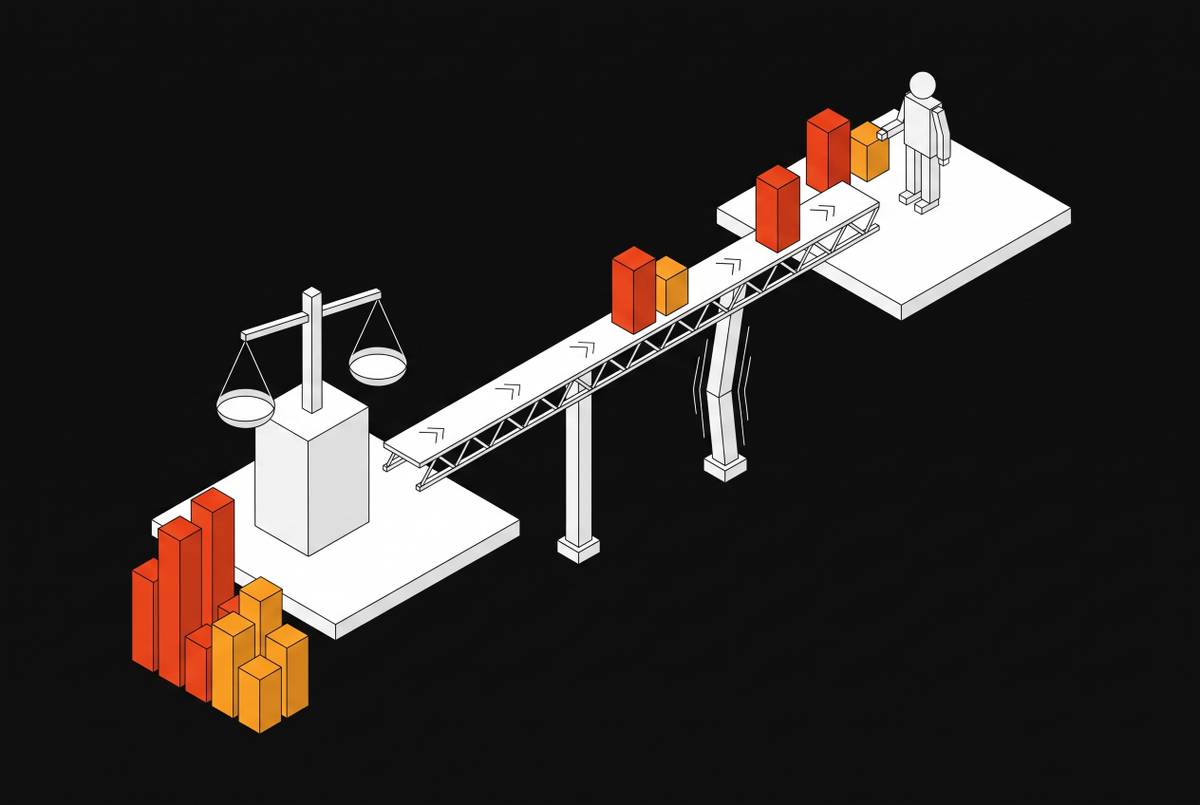
Human reviewers must be able to overturn AI judging decisions based on cited evidence.

A live voice debate platform with AI judging and a published scoring rubric is trustworthy only when its decisions cite what was said and can be challenged before a human reviewer with authority to change the outcome. For debaters, they make it possible to distinguish a judging error from a weakness worth correcting before the next round.
Why debaters need more than a score to trust an AI verdict
A debater loses a round but cannot tell whether the judge missed a decisive rebuttal or was right to find it too weak. The score does not resolve that uncertainty. Without reasons tied to the exchange, the debater has no way to distinguish a flawed call from an argument that genuinely failed.
AI judging removes the human bottleneck from structured debate, making scored practice available at scale. But scale does not establish that any particular decision deserves trust. The test is whether the debater can see what the judge read, which criteria it applied, and who can correct the outcome. Accountability begins where the bare score ends.
What a transparent AI judging system actually consists of
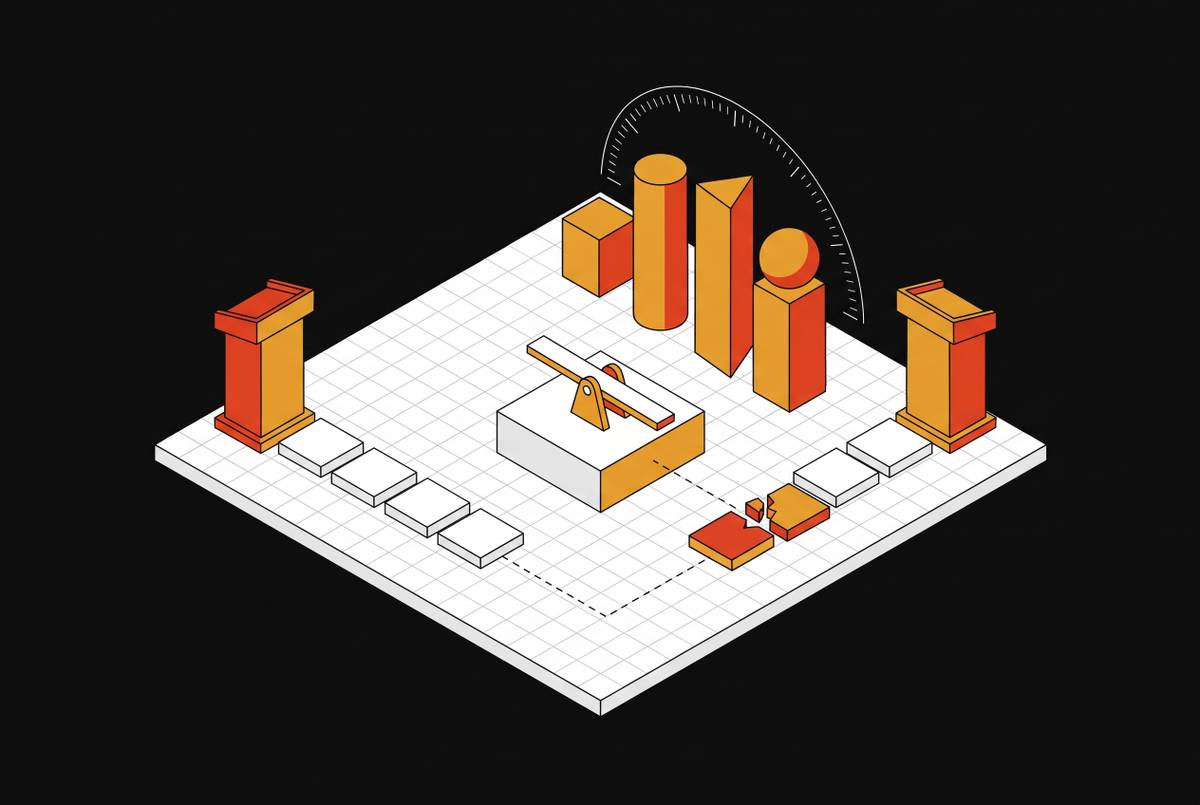
For judging to be transparent, three safeguards must work together: published scoring criteria that both sides can read before the round, decisions that cite what was said, and a clear path to human review. Each supports a different part of accountability. The criteria set the standard, the citations show how the judge used it, and the review path allows errors to be corrected.
Criteria revealed after a decision can be reverse-engineered to fit the outcome, while criteria published beforehand give both sides the same rules to use as they prepare and assess their arguments. Citations then connect those rules to the actual exchange. A debater can compare the judge’s reading of a passage with the transcript. The distinction is between an explanation that sounds plausible and one that can be checked.
A multi-model panel helps with another weakness, because a single LLM has only one point of view. Committees work more like human evaluation, where multiple annotators help reduce the bias of any one person. But multiple judges do not remove the need for correction. Human review lets a reviewer enforce the published rules and act on the cited evidence if they have the power to change the outcome.
How the appeal process works when a decision can be checked
For a debater challenging a decision, the first step is to compare its cited reasoning with the transcript and identify the passage at issue. The next step is to test that reading against the published scoring criteria. This narrows the dispute to a discrete discrepancy. The appeal can then explain what the judge missed or misapplied, rather than ask a reviewer to reconsider the entire round because the result felt wrong.
A claim that a rebuttal received insufficient credit becomes examinable when it identifies the rebuttal and the criterion that should govern its treatment. The reviewer can assess the alleged mismatch between evidence and judgment. An appeal must make clear which part of the decision is being contested and why the record supports that challenge.
GDPR Article 22(3) specifies rights to obtain human intervention, express a point of view, and contest the decision in the automated-decision circumstances it covers. These provide a useful legal analogue within the provision’s scope. The structure allows a person to bring forward facts or a perspective the system did not have and seek human reconsideration. In scholastic debate, the challenge procedure described for an opponent’s AI use stops the round and risks instant forfeiture if the accusation is wrong, illustrating why a low-cost review path is a substantive improvement.
Why the adversarial format itself makes AI verdicts more defensible than single-source consultation
An adversarial round gives each side a strong incentive to expose flaws in the other’s reasoning. Bad arguments face a motivated opponent rather than an unchallenged audience. This changes the judge’s task toward comparison, with competing arguments and rebuttals available for assessment. It gives the judge a contest in which weaknesses can be made explicit.
AI Debate Aids Assessment of Controversial Claims, published at NeurIPS 2025, tested debate against consultancy on contested factuality claims. The study found that debate consistently improved the judges’ accuracy and confidence calibration, even when they began with strong prior beliefs. AI judges with human-like personas had 78.5% accuracy, which was higher than that of both human judges and default AI judges without personas in the same study. Those results support adversarial evaluation within the tested setting. They do not establish that every AI panel will outperform every human judge.
For appeals, the consequence is a more demanding evidentiary standard than a general objection to automated judgment. An adversarial multi-model panel that cites specific passages gives more grounds for trust than a verdict from a single consultant model. A challenge should therefore show what held up against the opposing side’s attacks but the panel missed, or where the panel misread that exchange. The design is robust but fallible. Its strengths make precision in an appeal more important while preserving the need for human review.
The real failure modes in AI judging that make human review genuinely necessary
Judge hacking is more consequential than an isolated mistake. AI debaters can learn to exploit systematic weaknesses in a judge. Reinforcement learning research shows that optimization against a weaker judge can raise scores without making the arguments better. The score then rewards the evaluator’s preferences, which may diverge from what the evaluation was intended to measure. Human review is needed because a higher score alone cannot reveal that divergence.
AI Debaters are More Persuasive when Arguing in Alignment with Their Own Beliefs, presented at NeurIPS 2025, found that AI debaters were more persuasive when defending positions aligned with their prior beliefs. The study also found that models tended to prefer defending stances aligned with the judge persona over stances aligned with their own prior beliefs. Persuasiveness and correctness can therefore come apart. A judge’s response may reflect compatibility with its preferences. That possibility warrants scrutiny without making every persuasive argument suspect.
Sequential debate also introduces positional bias favoring the second speaker, a structural artifact. A human reviewer can examine and correct such a pattern where the scoring process fails to do so. For a debater, a defensible challenge identifies a specific instance of positional bias, sycophancy toward an argument style, or another scoring artifact in the transcript and decision. Documented weaknesses justify an effective backstop.
How AI judging holds up in high-stakes scored competition outside debate
Yuncheng Zhang, Ruojie Qu and Olivier Girard’s 2025 feasibility study examined AI video review for the 2024 Paris Olympic Taekwondo competition. It found strong agreement between AI-generated penalty decisions and international referees, with discrepancies in a small number of cases. Those discrepancies centered on head strikes with minimal contact or visual occlusion.
The study proposed AI-assisted pre-review, with a referee then confirming the decision in cases where the evidence was unclear. That supports a hybrid approach whose deployment at the competition remains unproven. Its relevance to debate is structural. AI can give a reliable baseline while human review deals with evidence that is unclear or in dispute. The most useful analogy for an appellant is the hard-to-read exchange, where interpretation needs examination.
How to read an AI decision as a training signal, not just a verdict
In debate practice, the cited reasoning is more useful than the win or loss alone. It shows which arguments the judge credited, which it found unclear, and where it identified logical gaps. A bare scorecard cannot supply that diagnosis. A human coach provides such feedback only intermittently, while AI judging makes it available across scored practice. The practical shift is to read the explanation as evidence about the performance before deciding whether to dispute the result.
The debater first checks whether the judge accurately represented what they said. That requires a comparison with the transcript. Intention and expression are not interchangeable evidence. The debater then checks whether the published criteria were applied consistently to both sides. Together, these checks separate a disagreement about the judge’s reading from a disagreement about its application of the rules.
For any passage the judge found unclear, the third check asks whether the argument itself was unclear or whether the format obscured the point. The fourth asks what would need to change in the argument to address the identified gap. If the decision exposes a real weakness, contesting the score would evade the useful feedback. If it exposes a misreading or inconsistent standard, the same analysis supplies the basis for a focused appeal.
This approach develops judgment as well as advocacy. A debater who reads decisions analytically becomes better able to recognize when the reviewer has something concrete to correct. The reverse is just as valuable. Recognizing that a criticism is supported by the record prevents an appeal from becoming a substitute for improving the argument.
When to appeal, when to accept, and how to make either choice improve your next round
The decision to appeal should turn on a specific, checkable claim. A legitimate challenge identifies a passage misread relative to the transcript, a criterion applied inconsistently across both sides, or a structural artifact that a human reviewer can verify. Naming positional bias or sycophancy does not establish that either caused the decision. The debater must show how the proposed explanation fits the cited reasoning and what was said in the exchange.
Acceptance is appropriate when that examination shows where the argument’s presentation or reasoning failed under the published standard. Correcting that weakness is the faster route to improvement than defending the original performance against accurate criticism. Distinguishing the two develops calibration, which is itself a competitive skill.
Both choices depend on access to an inspectable decision and meaningful review. Where those conditions are absent, the debater cannot reliably tell whether the apparent lesson reflects the performance or the evaluator’s error. Transparency makes that distinction available, but it does not make the choice on the debater’s behalf. Good use of an appeal mechanism requires the same intellectual honesty as good-faith argumentation, including the willingness to challenge a demonstrably wrong call and accept a demonstrably sound one, and platforms like Debatable, a voice-first 1v1 debate arena that posts its full scoring rubric before the round starts and routes contested verdicts to a human reviewer who can overturn them, make that standard something a debater can actually hold the system to.
Sources
- AI Debate Aids Assessment of Controversial Claims
- Faster, more accurate? A feasibility study on replacing human judges with artificial intelligence in video review for the Paris Olympics Taekwondo competition
- On scalable oversight with weak LLMs judging strong LLMs
- Fair and Responsible AI: A Focus on the Ability to Contest
- AI Debaters are More Persuasive when Arguing in Alignment with Their Own Beliefs