Logic Scoring Dimensions in Automated Debate Judgment
Separate scores for logic, evidence, and rebuttal make AI verdicts checkable.

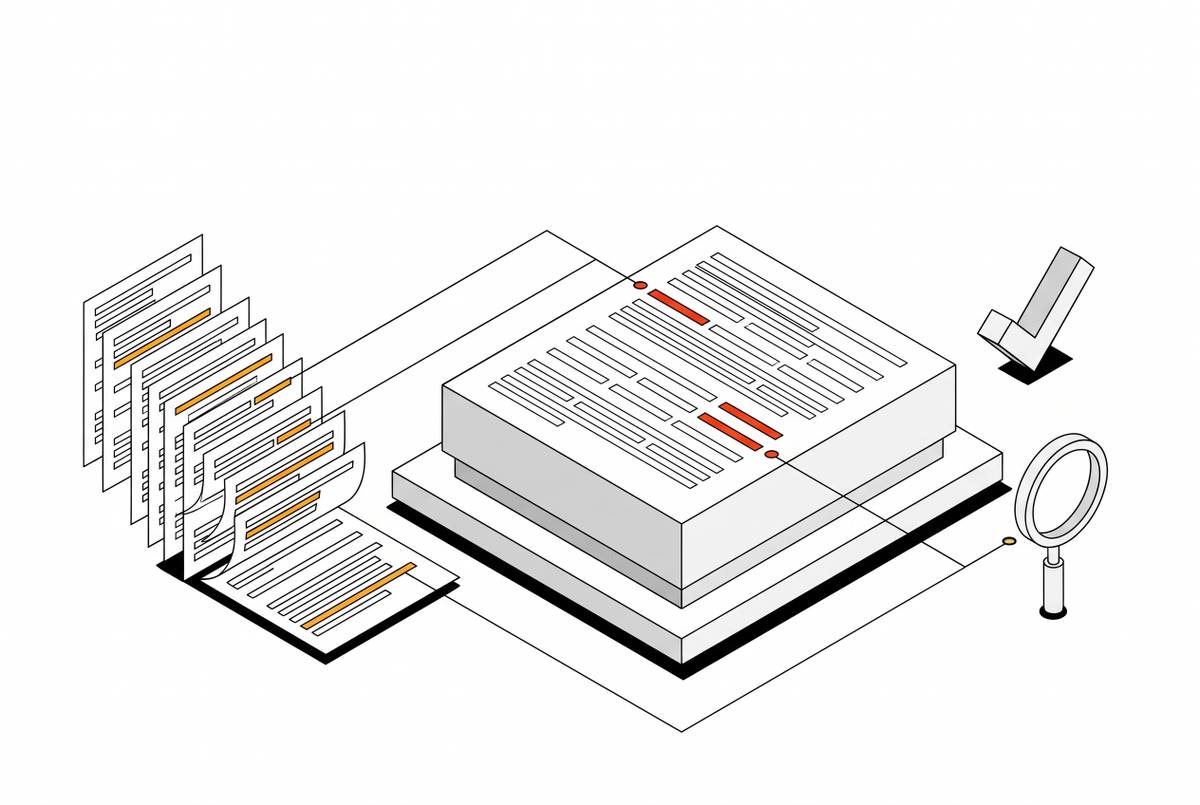
For a live voice debate platform with AI judging, a published scoring rubric should explain how reasoning, evidence, and engagement are judged separately. debAIt provides a concrete scoring example, with five weighted dimensions covering logic, evidence, engagement, clarity, and opening/closing. The central principle of automated debate judgment is that credibility comes from making those judgments distinct and inspectable.
Why a single debate score fails debaters who want to improve
A debater receives a verdict but cannot identify which argument lost the round. Was the evidence weak, the inference invalid, or the response to the opponent incomplete? The number provides no answer. Without reasoning tied to what was said, the debater cannot distinguish a fair assessment from a misreading, much less identify grounds for an appeal.
The problem begins when a scoring prompt conflates substance and presentation. A fluent, well-organized speech can score well despite thin evidence, because its clarity disguises its weaknesses. Style becomes a proxy for reasoning quality. Debate practice, however, is closer to chess training than classroom discussion, requiring an opponent, a score, and feedback precise enough to guide the next attempt. An opaque total records an outcome without explaining the moves that produced it.
What dimensional decomposition actually means in practice
Dimensional decomposition assigns each criterion its own evaluation before combining those evaluations into a verdict. A dimension is a bounded question about performance. Evidence quality asks whether a claim has adequate support, while clarity asks whether the claim is intelligible. Evaluating them separately is intended to prevent an impression of polished delivery from determining a judgment about factual support.
Debatrix implements this separation through multi-dimensional collaboration, with LLM agents focused on judging dimensions such as argument, source, language, or clash. Their analyses contribute to a summary judgment. The system also analyzes speeches chronologically rather than treating the full transcript as one undifferentiated text. Sequence is essential to judging an exchange. An argument may be introduced, challenged, and defended across speeches, so its final wording alone cannot show how well it survived opposition. PanelBench, introduced with Debatrix, tests the approach against the results of competitive debates in different formats and judging dimensions.
Separate scores also need safeguards against disqualifying failures. The Confident Liar evaluates instruction following, justification quality, and evidence grounding separately, together with a critical-failure flag. Such a flag identifies severe defects, including hallucinated evidence, major internal contradictions, or incoherent output, that cannot reasonably be offset by clarity. Consumer scorecards make the broader structure accessible to debaters. debAIt assigns its five dimensions separate point weights and presents a scorecard that can be read argument by argument.
What the core logic dimensions each measure, and why they are kept separate
Logical validity asks whether the conclusions follow from the premises. It checks reasoning chains, internal coherence, and logical fallacies, which takes more than checking whether a speech sounds convincing. Truth and validity are different tests. A valid inference can begin with a false premise, while accurate facts can be arranged into an invalid argument. InspireScore, introduced in InspireDebate, a paper accepted to ACL 2025, evaluates logical validity using first-order logic and treats it as an objective dimension, separate from subjective assessments such as clarity and emotional appeal.
Evidence quality asks whether claims have support from facts, data, or credible sources, and whether that support is relevant to the claim. It catches the elegant argument built on fabricated or unverified premises. Logical consistency cannot establish that a source is genuine. InspireScore uses search-based fact verification to check this, while the broader InspireDebate optimization framework also has Web-RAG for real-time fact augmentation. Debatrix also keeps source evaluation separate from argument evaluation because a claim said with confidence may still be unreliable.
Rebuttal quality asks whether a debater addresses the opponent’s actual arguments effectively. A speech can be valid and well sourced yet ignore the strongest objection raised against it, a failure of engagement. Scoring it requires attention to the exchange across turns, which explains the need for chronological analysis. debAIt calls this dimension engagement, while other platform rubrics use rebuttal strength.
Argument clarity evaluates precision of expression, examples, and intelligibility to a listener or reader. A clear explanation can still be logically defective. Separating the scores exposes that combination instead of rewarding it through a general impression of competence. InspireScore classifies clarity as subjective and logical validity as objective, preserving the distinction between how well reasoning is expressed and whether it holds.
Topic relevance asks whether the argument deals with the motion being debated. A compelling case about an adjacent issue may be accurate, coherent, and clear without answering the resolution. None of those strengths repairs the mismatch. InspireScore includes topic relevance as a subjective dimension because the fit between the argument and the motion needs to be judged on its own. Taken together, these distinctions make separation load-bearing, with each criterion catching a defect that the others cannot reliably detect.
How reading a verdict dimension by dimension turns a score into a lesson
When debaters read a dimensional verdict, they need to trace each score to an argument as well as check the final result. Each claim needs to be assessed on its own terms, including its support, its costs, and the people it affects. A cost claim cannot silently stand in for a fairness claim. A prediction about future effects must also earn its support independently of both.
A debater who loses on evidence quality but wins on rebuttal strength receives two different findings. The sourcing needs work, but the response to the opponent was effective. Those findings call for different practice decisions. Averaging them into a middle score would erase the distinction and could encourage the debater to change what already worked.
The explanation therefore belongs next to the score, in plain language. AI Senatus treats scoring as part of the debate, with reasoning shown beside each dimension score. Agreement is not required for the feedback to help. A debater can dispute an assessment while still locating the passage and inference responsible for it. Repeated weaknesses then become a training prescription, much as a chess analysis identifies which moves lost material.
Why dimensional transparency is the mechanism that makes AI judging credible
Being able to check a decision gives debaters a reason to trust it beyond how confident the judge sounds. A transparent verdict identifies the criterion applied, the speech content assessed, and the reason for the score. Debaters can dispute whether a particular claim lacked evidence or a particular rebuttal missed its target.
Published rules extend that accountability to the period before a round begins. Debaters can prepare for the criteria and later compare the decision with those same rules. Consistency is a prerequisite for meaningful rankings. An ELO or leaderboard based on standards that keep changing cannot be a reliable guide to skill, so the promise of automated judging depends on using the same rubric across matches.
The judge is supposed to assess argumentation strength rather than reward a preferred conclusion, and separate logic, evidence, and relevance scores make departures from that standard easier to challenge. They do not guarantee neutrality. Human review of appeals provides a further route for correcting an assessment that the automated process has mischaracterized.
Multiple judges add another form of scrutiny. With three independent judges, a single off-call need not determine the outcome, while differences between their assessments reveal where a verdict is contested. The Confident Liar uses rubric scores, confidence signals, and critical-failure flags together to check the quality of reasoning in more than one way.
The real limits of automated logic scoring, and what they require from system design
Separate dimensions make the structural biases of AI judging easier to expose and manage. A model may still judge in favor of the stance it prefers, and it may stick with its first judgment even as the exchange goes on. Neutrality therefore has to be addressed explicitly in the judging prompt. When the judge has to give separate reasons for logic, evidence, and relevance, it is harder to pass off a preferred conclusion as a judgment of the reasoning.
A further risk arises when an AI judge evaluates both human and AI-generated speech. An AI judge may favor expression in a stylistic “dialect” that another model produces readily. This can put humans at a disadvantage even when their reasoning is just as strong. Dimensional separation helps show when style gets more weight than substance, but it does not prove that the judge has stopped favoring model-generated language. This remains an active research problem.
There is also a practical cost to more detailed evaluation. Scoring each dimension on its own takes more time and leads to longer verdicts than giving a single total. If a debater cannot follow the explanation, a structurally sound evaluation still fails as feedback. Presentation must therefore keep the link between score, argument, and reason easy to read without collapsing distinct findings back into a general impression.
The design response is to publish rules before the round, cite what was actually said for every dimension, permit appeals, and use multiple independent judges. These safeguards address different weaknesses and complement one another. None is a claim of perfect accuracy. A platform that gains nothing from one side winning also has one less reason to favor an outcome, though model bias remains.
How to use dimensional verdict feedback to build a real debate practice habit
Begin with the dimension showing the largest gap between your score and the opponent’s, then trace the written explanation to the argument where that gap opened. The diagnosis should precede the drill. When evidence scores stay low, sourcing habits need work, while low engagement scores call for work on how opposing claims are answered. Low logical-validity scores call for work on how arguments are built.
The resulting practice loop is straightforward. Argue a round, read the verdict by dimension, identify the weakest dimension, and run a targeted drill before debating the same or a related motion again. The drill may use solo AI rounds, live 1v1 matches, or preparation for a specific topic. Immediate AI opponent rounds with instant scored verdicts reduce the need to arrange a partner before starting. Where platforms also have leaderboards and ELO-style rankings, debaters can check changes in rank against changes in their dimension scores, since rank alone does not prove they have improved.
For students and teams, this process gives each completed round a written decision that can support independent review. A coach can then use the feedback as a starting point for a targeted session on a specific disputed inference, unsupported claim, or unanswered objection. Using the same rubric at every level also helps teams with less funding get access to structured practice. The broader value is that disagreement becomes a set of trainable skills, with logic, evidence, engagement, and clarity made visible enough to work on beyond competitive debate.