Hallucination Rates in Voice AI Evidence Citations
Language models generate plausible citations without verifying they exist or support the claim.
Voice AI evidence citations are a verification problem. Language models can produce references that sound authoritative without establishing that the sources exist or support the argument. Hallucination rates therefore describe a structural risk. Responsible use starts with understanding that mechanism and treating every generated citation as a hypothesis until the original source supports it.
Why voice AI citation hallucinations are a structural problem, not a random failure
A bug departs from intended operation, while citation fabrication can arise from a language model operating normally. Calling it a design feature leaves open that fabrication is unwanted and was never asked for. It means that the architecture allows plausible text to stand in for verified evidence. A well-formed request can therefore receive a well-formed reference to a nonexistent paper. That can still happen even when users give better instructions.
The mechanism is fluency bias. Language models predict which words should follow each other, so the shape of an authoritative reference can be reproduced without its factual foundation. When voice AI is used to prepare for debate, do legal research, or build academic arguments, that difference matters whenever its words are used as evidence. The structural liability begins when plausibility is mistaken for verification. Mitigation must address that gap rather than assume that a more careful user would never encounter it.
How language models generate text, and where citations go wrong in that process
Citation generation requires a different kind of precision from a plausible paraphrase. A reference must identify a specific source through details including author, title, journal, volume, and DOI. Those details must belong together. Yet the model chooses its next token through statistical likelihood, with no built-in check that it matches the facts. A citation that sounds right can therefore emerge through the same process as one that is right.
The resulting failures are distinct. Total fabrication supplies a paper that does not exist, while semantic hallucination attributes a claim to a real paper that does not make it. Identifier hijacking supplies a working DOI or URL for an unrelated paper, giving false support a veneer of legitimacy. A bibliographic error concerns an existing paper whose author, date, journal, or DOI is wrong. The NeurIPS 2025 GPTZero taxonomy identifies Total Fabrication as the dominant primary failure type, while semantic hallucination accounts for 63% of secondary/compound characteristics despite being the rarest primary type.
Mathematical research gives the mechanism a deeper foundation without making every error unavoidable. Peng, Narayanan & Papadimitriou establish specific hallucination-inducing limitations of the transformer layer, while Banerjee et al. and Xu et al. establish limitations applying to any computable LLM regardless of architecture. These results show why cutting down on hallucination differs from getting rid of it. They do not supply a single expected error rate for every practical citation task.
Why every hallucination rate you've seen is measuring something different
A hallucination rate is meaningful only in relation to the task and the failure being counted. Summarizing a supplied document tests something different from recalling a reference without that document. Answering an obscure factual question also tests whether a model abstains when it lacks knowledge. Apparent contradictions between scores can therefore reflect different measurements.
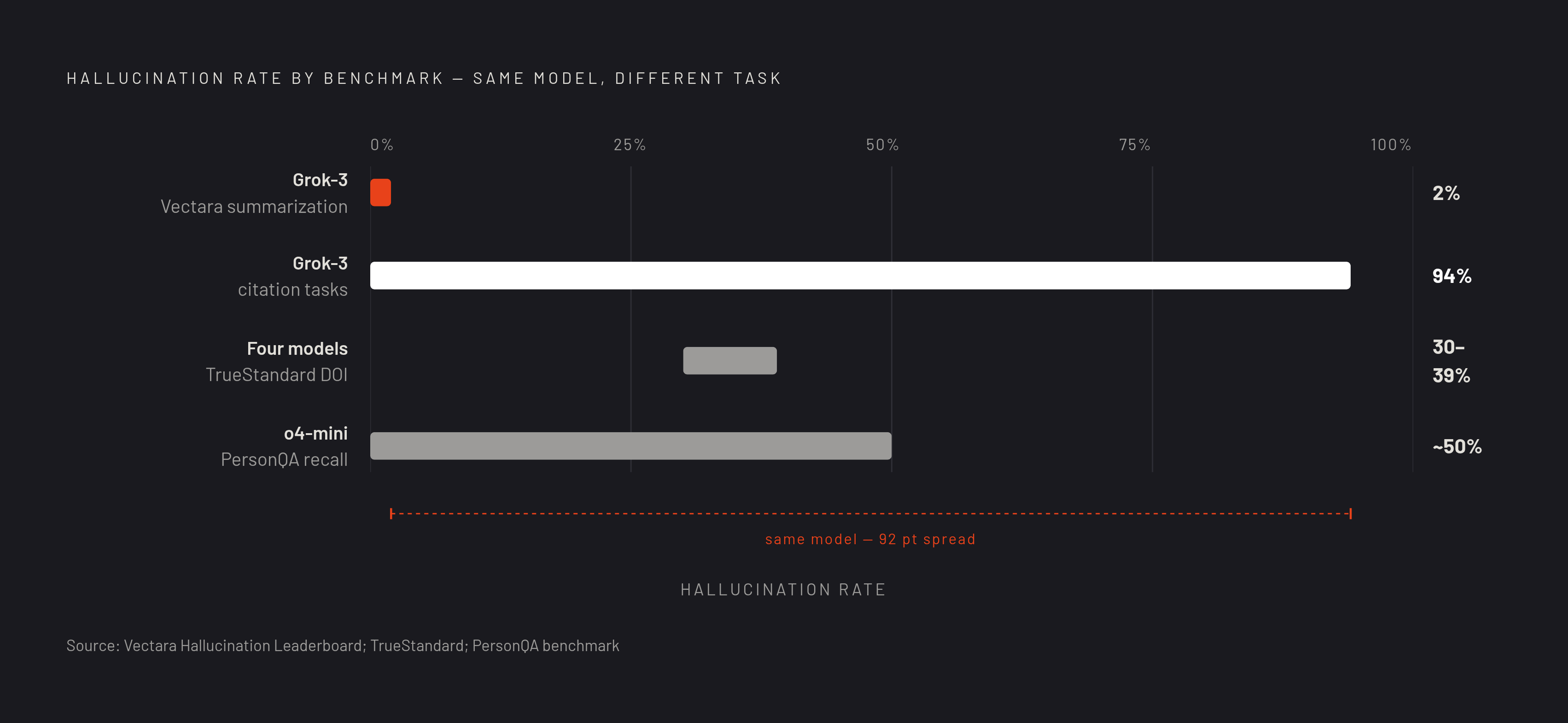
Grok-3 illustrates the problem. Vectara's summarization benchmark placed its hallucination rate at around two percent, while a citation test in the same time period put it at ninety-four percent. The first result concerns faithfulness to material the model is handed. The second concerns citation performance, where producing the right source is itself part of the task. Neither number can stand in for the other.
The main 2026 benchmarks make these distinctions concrete. AA-Omniscience tests whether models guess rather than abstain when they do not know, with rates of roughly twenty to ninety-four percent across models. Vectara HHEM measures grounded summarization, where the best models perform well. TrueStandard's citation benchmark resolves DOIs against Crossref and DataCite and found that roughly thirty to thirty-nine percent of offered DOIs did not resolve across four models. OpenAI PersonQA asks factual questions about people, so it tests how well a model recalls facts without directly checking whether its citations are valid. A strong summarization score is therefore not evidence that a model can safely supply unverified references.
The counterintuitive finding that newer, more capable models hallucinate more on citation tasks
On some evaluations, newer reasoning models hallucinate more than their predecessors, closing off the assumption that upgrading is sufficient protection. This is a pattern in current results. It also requires care about scope, because evidence from factual recall informs the citation problem without becoming a citation-specific measurement.
OpenAI's own PersonQA benchmark found that o3 hallucinated at roughly double the rate of o1, while o4-mini reached nearly half of all answers hallucinated. AA-Omniscience's leaderboard as of October 2026 likewise finds that the majority of tracked models are more likely to hallucinate than to answer correctly. Gemini 4 Argon holds the lowest hallucination rate among models answering at least forty-five percent of questions correctly. It became publicly available on October 13, 2026, for Google AI Pro and Ultra subscribers and paid API users. Even the best publicly available model still hallucinates on a meaningful share of queries.
Together, these findings challenge the idea that reasoning performance can serve as a proxy for evidence reliability. Reasoning depth and citation accuracy appear to pull in opposite directions for current architectures in some settings. The practical conclusion is narrower than declaring newer models worse at everything. Model upgrades are not a substitute for citation verification.
What citation hallucinations cost in the arenas where evidence is verified — law, science, and competitive debate
The liability becomes tangible when an authoritative-looking reference reaches a setting that checks sources. A citation can survive casual review because its form is familiar, then fail when someone looks for the underlying authority. Legal filings show both major versions of this problem, namely invented sources and real sources that do not support the stated proposition. The distinction matters because checking existence alone addresses only the first.
On 18 March 2026, Deborah Leslie, the Assistant District Attorney for Clayton County, Georgia, appeared before the Supreme Court of Georgia. Chief Justice Nels S. D. Peterson identified at least five fictitious citations in the filing, plus five others that did not support the propositions for which they were cited. The Supreme Court vacated the lower court's ruling and suspended Leslie from practice before the court for six months. The case demonstrates that a citation's validity includes both its existence and its relevance.
Sullivan & Cromwell submitted an apology to the U.S. Bankruptcy Court for the Southern District of New York in April 2026 after hallucinated legal citations were discovered in a filing for Prince Global Holdings Limited. By early August 2026, thousands of court decisions involving AI-hallucinated content had been logged. That broader category places citation failures within a substantial problem of AI-generated material entering legal proceedings.
A 2025 study in JMIR Mental Health tested GPT-4o across simulated literature reviews and found that roughly one in five citations pointed to nonexistent papers. Of the citations to real papers, nearly half contained bibliographic errors, most commonly incorrect or invalid DOIs. These were literature-review results. Their relevance to debate is the failure mode, because evidence there must be verifiable and directly quoted, making a fabricated citation a rule violation.
Why the problem is hardest precisely on the topics where debaters and researchers most need citations
Citation fabrication is more likely when the request is for niche topics, recent evidence, or specific statistics. These are also the materials researchers and debaters seek when building arguments beyond familiar ground. A broad answer on a settled subject cannot take the place of a precise finding from new research. The demand for specificity therefore concentrates attention on tasks where factual citation performance is weakest. This mismatch remains even when a model does well at other tasks.
A student whose school lacks a well-resourced research operation may reasonably turn to AI tools to help close the gap. That potential benefit cannot be assessed through speed or access alone, however. If the resulting references are fabricated, the student has gained only the appearance of research.
The educational risk extends beyond invalid citations. Anthropic's April 2025 analysis of a large sample of student conversations with Claude found that nearly half were “direct” interactions in which students sought answers with minimal cognitive engagement. That finding identifies a dependency risk relevant to debate education. Independent argumentation is the purpose of debate practice. AI-assisted preparation without verification may therefore weaken the very skill it appears to support, even when a particular citation happens to be accurate.
What actually reduces citation hallucination, and what doesn't
The value of mitigation depends on the failure it targets. Asking several models the same question can expose disagreement that a single answer conceals. Suprmind's Multi-Model Divergence Index finds that each multi-model turn brings out views that a single model missed, and that answers to financial questions differ most often. When much is at stake and the task depends on citations, such disagreement is a warning. Agreement, however, is not the same as resolving a source and reading it.
Multi-agent evaluation frameworks produce judgments that line up more closely with human judgments than those from single-agent prompting. That improvement does not establish that the underlying references have been checked. A system capable of identifying logical fallacies may still reward a well-structured argument built on a fabricated citation. Argument quality and source validity remain separate tests.
Institutional standards make that separation consequential. ACL issued an official statement in 2026 on desk-rejecting papers with hallucinated references. arXiv moderator Thomas Dietterich announced a one-year ban for researchers who submit papers with unambiguous hallucinated references. These policies put responsibility on the submitted work rather than on the fluency of the tool that helped produce it.
The most reliable mitigation remains manual DOI and source verification. The researcher must establish that the paper exists, that it supports the attributed claim, and that the specific quotation appears in it. A working identifier clears only the first barrier if it leads to the correct paper. Reading for support addresses semantic hallucination, while checking the quotation tests the exact evidence being offered. No current mitigation eliminates citation hallucination, so human verification remains necessary.
What responsible use of AI-generated evidence looks like in live, judged debate
Responsible use treats an AI-generated citation as a hypothesis to investigate. Every DOI or URL should be resolved before the citation is used. The paper's existence and the specific claim attributed to it must then be confirmed in the original document. Quoted statistics and findings require comparison with that document. Citations on niche or recent topics need a closer look because the risk is higher for those topics.
Live, spoken, judged rounds give evidence quality a direct role in evaluating an argument under pressure. That value depends on checking evidence before the round. Otherwise, fluent delivery can carry an unsupported premise into the assessment of logic and response. Preparation must distinguish what the source establishes from what the generated answer merely asserts. The round should test argumentation built on verified evidence.
AI judging can reflect the same standard when its scoring criteria are published in advance, its citations come from what was actually said, and its verdicts are appealable. Transparency must include what the system can and cannot check, with human review as the backstop. The goal is not to avoid AI assistance but to keep its output within a clear boundary of trust. Building an argument from verified evidence is itself a debate competency. Understanding hallucination rates helps preserve that competency when fluent output is easy to obtain.