Latency Constraints That Separate Real-Time AI Judging From Asynchronous Review
Live verdicts must weigh immediate usefulness over analytical depth within seconds.
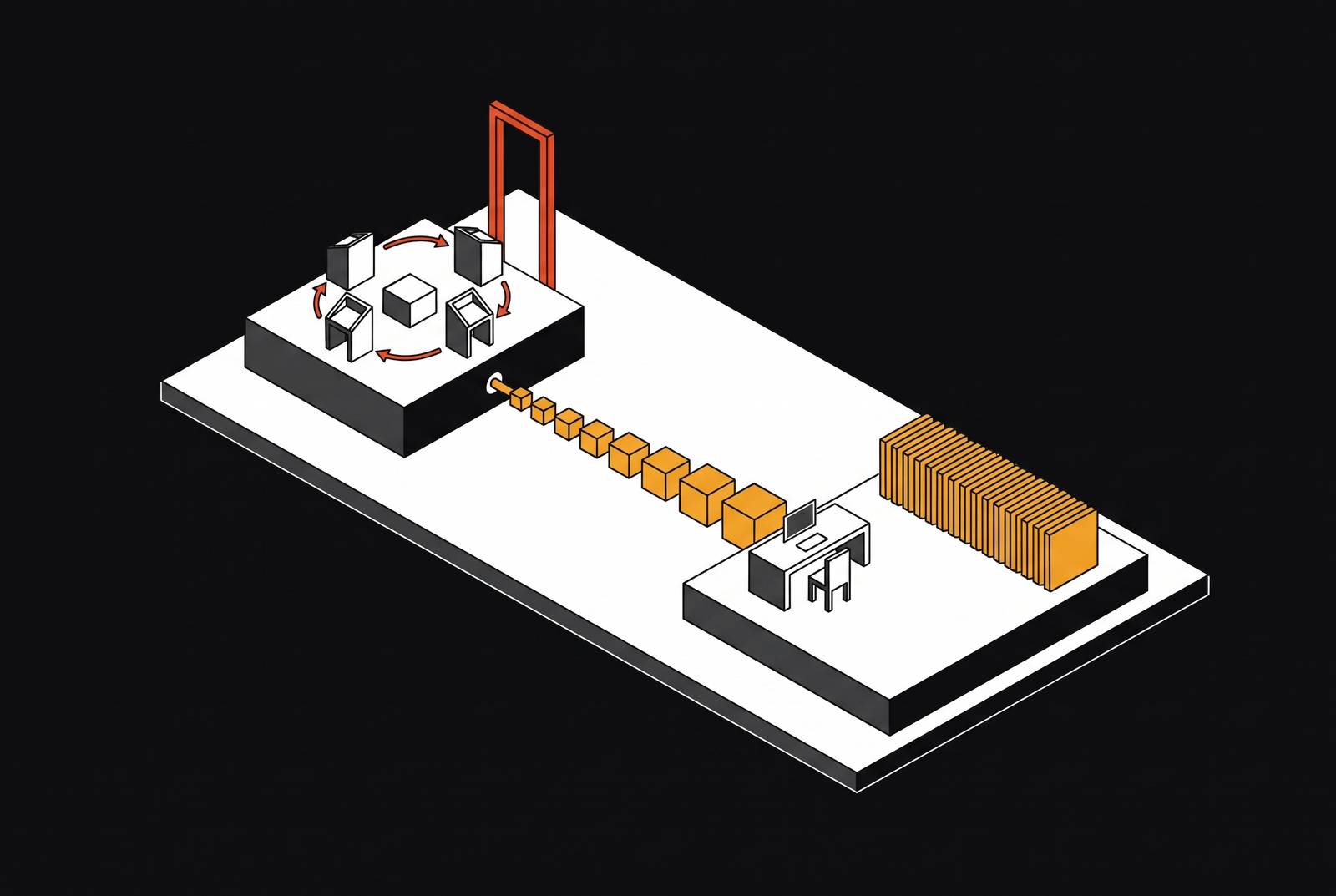
A live voice debate platform with AI judging and a published scoring rubric has a different job from asynchronous AI review. Its verdict must explain a spoken performance within the time available for the next round, using criteria debaters could see beforehand. Latency constraints make that judgment architecturally distinct from a deeper review of the completed transcript.
Why the same LLM cannot do both jobs equally well
A verdict delivered seconds after the final speech can shape how a debater prepares for the next match. A more detailed decision that arrives the following morning comes too late to help with that next match. For a live platform, analytical depth has value only within a response time that preserves the feedback loop between one performance and the next.
Real-time judging and asynchronous review place different demands on context handling, inference time, and scoring depth. A model chosen for deeper analysis must give up some of that depth to meet a live deadline, while giving a constrained live judge more time to respond does not by itself give it holistic judgment. Treating the modes as interchangeable leads both engineers and debaters to expect the wrong things from a live ballot.
How transformer attention turns context length into a latency problem
Self-attention supplies a basic reason for the trade-off. In the attention computation described here, every token in the context window is compared against every other token. The scaling is quadratic. Doubling the input therefore more than doubles the attention computation, so the work grows faster than the transcript does.
A debate transcript makes this problem difficult to avoid. Speakers build on earlier speeches, rebuttals refer back to claims, and a fair judgment must keep track of how those exchanges fit together. Feeding the full, unfiltered transcript into an inference pipeline puts that entire context burden ahead of the verdict and can push the response beyond the time in which it remains useful during the same session.
Users saw the response start sooner, but the total generation time stayed the same. A partial ballot is still not a usable ballot. Streaming improves the experience of waiting, but reasoning-optimized frontier models still trade inference speed for analytical depth, making their richer analysis better suited to asynchronous review than to a live judging deadline.
The two-tier framework that production teams have settled on
The production distinction between synchronous and asynchronous evaluation follows the function of the result. Synchronous evaluation handles gates, including safety-critical checks, whose decisions must affect what is happening at that moment. Asynchronous evaluation checks aspects of quality that need deeper analysis without making that interaction wait. A more elaborate evaluation is not automatically the right evaluation to put in the live path.
Applied to debate, a rules-violation check that must intervene during a round has to be synchronous. An inline judge expected to catch a fabricated citation must also do so before the round goes on. That requirement sets which checks must fit the live budget, while comparing persuasion arcs across complete speeches belongs in the asynchronous tier because it needs more context and more time for analysis.
The cost structure reinforces this separation. Batch inference APIs from major providers cost much less in return for a multi-hour service window. Delayed completion is part of that product’s design. It permits work that does not need to block a user, whereas the synchronous tier exists precisely because some decisions cannot wait. For debate systems, the resulting mental model is a live path for time-dependent judgments and a separate review path for depth.
What a real-time verdict can legitimately score — and what it cannot
A live verdict can credibly assess dimensions that are visible as the transcript develops. Clarity includes jargon, sentence structure, and ambiguity. Relevance covers whether an argument speaks to the topic or the opponent’s last point, while evidence quality covers whether a claim has a fact, example, or logical chain to back it up. These are suitable targets for incremental evaluation. Their scope gives a debater concrete grounds for trusting a bounded verdict.
Evidence scoring still needs a clear boundary. Assessing whether a speaker supplied support is not equivalent to establishing the truth of every factual assertion. Similarly, recognizing a response to the opponent’s latest point is narrower than tracking every refutation across the round. Full-round persuasion analysis, cross-speech refutation tracking, and comparative weighting of competing frameworks demand holistic judgments over the complete exchange. Those dimensions benefit from the inference time that asynchronous review can provide.
Live conditions also change some sources of bias. Timed speaking limits constrain the verbosity that can otherwise lead judges to favor longer answers over concise, correct ones. They do not remove position bias. A model may favor the argument presented first or last in a pairwise prompt, and that risk exists in both live and asynchronous judging. Rubric design and multi-model panels address that structural problem more directly than switching from one evaluation mode to the other.
How can a live debate platform show exactly how it scores?
Visible scoring rules turn a technically bounded verdict into a standard a debater can understand. If the criteria emerge only after the round, several different rubrics could be used to justify the same output. Publishing the criteria and their weights beforehand gives the debater a known relationship between the performance being requested and the judgment that will follow.
If clarity and relevance have more weight early in the round and persuasion has more weight at the close, debaters can plan for those weights. The condition must be visible before they speak. Otherwise, a decision may look precise while judging speakers by standards they never had a chance to meet.
Fallacy detection makes the distinction especially clear. Flagging an ad hominem or straw man provides useful feedback when debaters knew that fallacies would be tracked and weighted. An unexpected retroactive flag instead functions as a penalty. Appealability adds a second requirement, because a decision that cites what was actually said can be checked against the round. A number without those references cannot support the same scrutiny, and unchecked decisions can erode participation even when the underlying model is technically capable.
How async AI review fits into debate prep without replacing the live round
For coaches and self-directed learners, the practical division is to use asynchronous tools to prepare a case and live judged rounds to test its delivery without a script. Case analysis, argument construction, cross-examination anticipation, and post-round rhetorical breakdowns benefit from longer context and more inference time. Preparation gives those tools room to work. The live round then tests whether that work has become knowledge the speaker can use.
That distinction is essential when AI generates arguments. Students who have not internalized those arguments can answer more practice prompts correctly with assistance yet struggle to pronounce and deploy the same ideas under pressure. A prepared answer is not spontaneous command. Live speaking introduces time pressure, public exposure, and irreversibility, so the performance tests a skill that asynchronous revision cannot supply on its own.
Research benchmarks operate on the other side of that boundary. The LLM Debate Benchmark, as of October 15, 2026, contains thousands of complete side-swapped matchups and tens of thousands of judge decisions across 683 topics. Its judges evaluate completed transcripts after the fact. That design illuminates model capability, but it imposes no live-round constraint, so its findings do not transfer directly to real-time judging design. For preparation, the distinction supports a complementary use of AI review rather than a substitution of transcript analysis for spoken practice.
What the judge-hacking risk reveals about real-time scoring design
The strongest objection to lightweight judging is that debaters may learn to satisfy the judge at the expense of improving the argument. A low-latency judge operates with a smaller model or a more constrained inference budget, and smaller models with fixed rubrics are more vulnerable to that manipulation. A public rubric does not settle this problem. Transparency makes the standard legible, but the judge must still distinguish genuine performance against that standard from rhetorical moves that exploit its weaknesses.
Research on RL-trained debate agents illustrates the failure mode. With a weak judge, alignment can degrade after a small number of training steps, driven primarily by an increasing rate of correct arguments being rejected. The error is not merely generosity toward weak claims. It can become a preference for rhetorical attacks over logical validity, undermining the very distinction a debate judge is supposed to preserve.
An October 2026 preprint found that debate increases accuracy relative to prior beliefs for human judges, while weaker language models show mixed results. Some improve, while others decline in accuracy. That division prevents an easy inference from the benefits of human debate to the reliability of an automated judge. Real-time systems face pressure to constrain their judges, precisely where vulnerability to judge hacking becomes a serious design concern.
The design response is to distribute and discipline judgment. A panel of independent models reduces the chance that a single model’s bias dominates, while rubrics can explicitly discount length and reward direct refutation. Citation requirements add an evidentiary anchor. By requiring judgments to connect to what was actually said, they make rhetorical gaming harder and make the result more checkable. These are mitigations rather than grounds for claiming immunity, but they form a coherent response to the risk without abandoning live evaluation.
Why the constraints on real-time judging are also the conditions that make live debate worth doing
The live judge’s constraints correspond to the conditions under which the speaker performs. The debater has a clock, a developing exchange, and no opportunity to revise an earlier speech after hearing the final response. The judge evaluates that same bounded event. Limited time and context are therefore not simply defects relative to asynchronous review, although neither condition excuses an unreliable or opaque decision.
The appropriate output is a scored, citable, transparent account of the performance that occurred. It should show whether the argument landed and identify the spoken evidence for that judgment. Exhaustive analysis belongs to the later review.
Access to that feedback loop has historically depended on membership in a well-resourced team with experienced human judges available. Real-time AI judging gives people outside those teams immediate feedback on the spoken round. For someone with an opinion and an internet connection, the significant opportunity is to speak under pressure, receive an accountable judgment, and enter the next round better prepared.