Live Voice Debate vs. Asynchronous Written Debate for Skill Building
Written debate builds the case; live voice tests whether it holds.
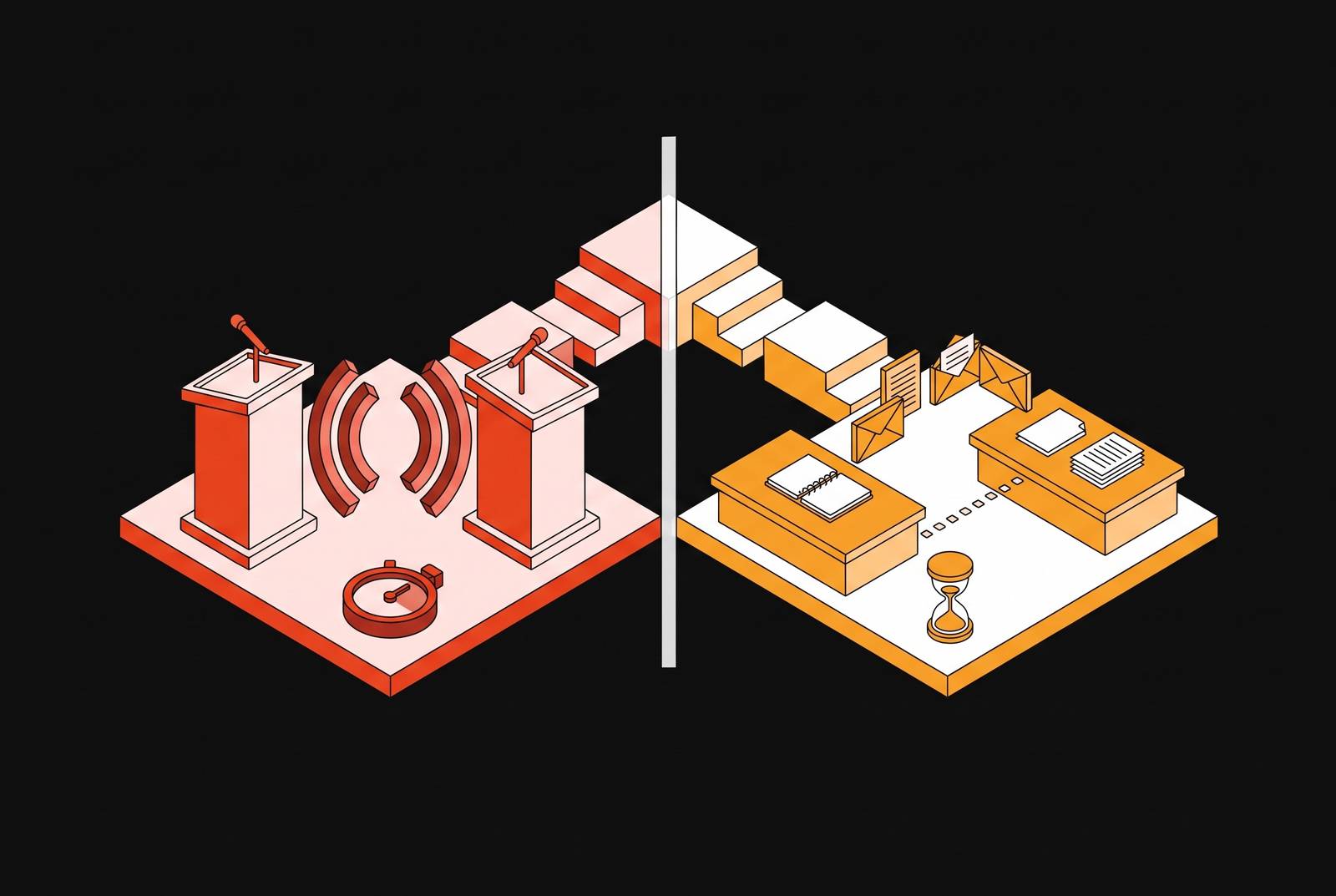
Live voice debate and asynchronous written debate build different skills, so daily practice without a partner must match the intended performance. A solo AI debate opponent is useful for live argument training when practice includes timed spoken responses and judging against published criteria. Writing develops the case. Live voice develops the ability to defend it under immediate challenge, and explained verdicts turn that practice into a training loop.
Why live voice and async written debate train genuinely different skills
Debaters and learners often choose a practice format for convenience while expecting the same improvement from either one. That assumption confuses the quality of an argument with the ability to deliver and defend it in real time. A carefully revised case can show that someone reasons well without showing how fast they can respond. The practical stakes are substantial. Someone preparing for a live debate needs practice that tests what happens when revision is no longer available.
The clearest distinction is between an artifact skill and a performance skill. Written debate trains the quality of what a participant produces, with time to reconsider claims before submitting them. Live voice debate trains the quality of what a participant does during a single event, without a revision pass. The demands differ before either argument is judged.
What async written debate actually trains — and what it cannot
A writer can examine evidence, organize a case, and consider whether a counterargument exposes a weak premise before replying. This makes the format a good way to learn how to build long-form arguments, choose evidence, and organize a case. Revision is part of the training. It allows the participant to improve the relationship between a claim and its support rather than defend the first formulation that comes to mind.
That strength also defines the format’s limits. Time spent considering a counterargument does not reproduce the task of tracking an opponent’s speech while forming an immediate answer. Written exchanges do not require vocal conviction, controlled pacing, or the management of speaking time under direct challenge.
Access changes how those limits should be judged. NOF Async Debate lets students take part through recordings without having to find a shared time or travel, removing a barrier for those in under-resourced schools. Even its finalists have forty-eight hours to record a rebuttal, preserving time to prepare. That design serves a legitimate educational purpose. Its value should be judged by the chance it gives students to take part, even though it does not make all the same demands as live competition.
What live voice debate demands that written practice structurally cannot replicate
The debater must remain calm, follow the opponent’s reasoning, formulate a response, manage time, and speak with conviction before the opportunity passes. There is no separate revision stage. A weakness in one task can constrain the others because the response must be reasoned and delivered within the same performance.
Carnegie Mellon’s TreeDebater research identifies time constraints and back-and-forth interaction as central challenges in competitive debate. Limited speaking time forces strategic choices about which points to pursue rather than permitting coverage of every possible argument. Selection becomes part of the skill. A debater must predict, respond to, and adjust around the opponent’s arguments while deciding which challenge deserves the remaining time. Written preparation can supply possible answers, but it cannot make that decision under live conditions.
The same research explains why persuasiveness cannot be evaluated from a single final game status alone. An argument’s force depends partly on how it answers what came before it, so the interaction itself must be considered. Delivery shapes that interaction through pacing, signposting, emphasis, and pauses that help make reasoning intelligible as it unfolds.
The bridge format: what recorded speech submission does and doesn't solve
Recorded speech submission adds spoken performance without requiring everyone to attend at the same time. The NOF format illustrates this bridge through a recorded constructive speech, judge feedback, and a recorded rebuttal in the final round. Compared with pure text, a recorded take introduces vocal delivery, timing, and the commitment of a spoken performance. This is a meaningful addition to written preparation.
The missing element is an opponent responding in real time. A prepared recording cannot require immediate adjustment to an argument as that argument is being delivered. Recorded rounds can bring more students into structured competition and develop parts of oral performance. They remain an access solution rather than a substitute for live rounds when the goal is responding under immediate challenge.
Matching format to goal: when async writing is the right tool and when live voice is
The practical decision begins with the intended task. For a stronger legal brief, policy memo, or persuasive essay, asynchronous writing directly trains the artifact that will be assessed. Evidence command and case architecture deserve priority there. For a live argument, interview, courtroom exchange, or debate round, the learner also needs practice responding aloud without an editing interval. The format follows the goal rather than a general ranking of which kind of debate is better.
Access then determines which practice is feasible. For students who cannot coordinate live scheduling, an asynchronous program offers structured participation where the alternative may be no debate at all. Recorded work can develop delivery, while written work can strengthen reasoning, even when neither supplies immediate opposition. Recognizing the gap allows the learner to understand what remains untrained without devaluing the work already possible.
For competitive debaters targeting live circuits, the recommended anchor is a full judged practice round each week. The round must include an explanation of why a side won. A conversation requires listening and answering during the encounter, even when it has no formal motion or winner. Written preparation supports that task, but live voice practice trains the performance the encounter actually requires.
Why judged rounds matter more than format for actual skill development
Format exposes the learner to specific demands in practice, while judging provides a usable correction. An unjudged exchange can confirm whatever the loudest or most confident participant already believed. Confidence is not an external standard of quality. A verdict with a reason challenges the participant’s interpretation of the round by distinguishing the argument actually made from the argument they intended to make. That distinction is the basis of useful feedback.
A learner needs to know whether a response engaged the opposing claim and whether the reasoning supported the conclusion. A result alone cannot explain either point. Debate coaching gives learners an outside judgment of how they performed, which they may not get from self-study or talking with peers. Hearing another position can broaden critical thinking in either format, but a verdict teaches only when it explains its grounds.
For teams without coaches, access to judging can therefore become the binding constraint. Changing the topic or giving learners more time to prepare still leaves them without that outside judgment. Quality human judging is scarce and difficult to coordinate. This changes the question from which format is easiest to arrange to which practice can provide dependable feedback on the skills being trained. AI judging can help teams get that feedback if they know what it judges and how it scores.
How AI judging works and what it can reliably score in a live voice round
AI judging is most useful for defined structural criteria, including logic, argument quality, response relevance, and clarity. These criteria test whether the reasoning holds together and whether a response answers the argument that was made. They are narrower than complete human persuasiveness. Published rules allow the learner to understand what the judge is assessing before speaking, rather than infer the standard from an unexplained score afterward. That transparency makes the verdict more useful as a training signal.
Multi-agent judging extends this approach through mutual challenge among several models evaluating content through debate, discussion, or voting. Research on multi-agent debate evaluation found a 10–16% improvement in correlation with human judgments over single-agent prompting on open-ended dialogue response generation benchmarks. The scope of that result is important. It supports the approach to evaluation, but it does not establish the same improvement for live voice rounds or every dimension of spoken persuasion.
The TreeDebater research also reports that human evaluators rate AI debaters as less convincing than human opponents in live debates. That finding shows how AI performs, without directly testing AI judging, but it gives grounds to ask how well AI models the way humans persuade. The two questions should not be conflated. Structural scoring can be useful even when a system is less dependable at evaluating holistic persuasion or nuanced philosophical clash. Those limits still hold with a multi-panel design.
An AI judging tool should be assessed by its published criteria and the reasons attached to its verdicts. Argumentation, structure, evidence, and logical consistency give the judge clear things to assess in its feedback. Holistic persuasion requires more caution in interpreting scores. Rules published before the round make the assessment legible, while references to what was actually said connect the result to the performance. A panel or a confident explanation still needs that link to what was said.
How can you practice debate every day without a partner and build live voice skill?

A workable practice architecture combines daily solo drills, weekly judged live rounds, and feedback review in that sequence. Each layer has a different job. Drills work on one weakness at a time, rounds bring weaknesses out under pressure, and review shows what the next drills should work on. Someone seeking a solo AI debate opponent needs a tool that supports the intended task during an exchange. The notes establish criteria for useful practice when arguing both sides alone.
Daily solo work can begin with one-minute openings. The learner draws a motion, prepares briefly, and delivers the opening three different ways to practice case construction speed and delivery under time pressure. Rebuttal reps then turn attention toward the opposition. The learner writes a strong argument for the opposing side and answers it aloud in ninety seconds. This gives the learner practice forming a response without a partner, though an opposing argument prepared in advance cannot be as unpredictable as a live opponent.
Rebuild drills work on positions that failed before or were hard to defend. The learner reconstructs the unsuccessful case differently, practicing adjustment. The live 1v1 judged round each week then tests those skills together. Rounds show weaknesses but leave no time to focus on each one, so practice needs a balance of rounds and drills. Alternating judged performance with targeted work gives the feedback a specific place to go.
Review closes the loop by examining a verdict that cites what was actually said. A verdict without those references is an opinion. For competitive students targeting World Schools circuits, the ESU Schools’ Mace program offers a seven-session scaffold in materials published 18th September 2026. Session 4, Listening and Response, develops rebuttal skills and introduces Points of Information. Within that practice structure, written preparation builds the case, but the live round tests whether the learner can adapt it when an opponent changes the argument.