The Case for a Single Judged AI Round Every Morning Before the Day Has a Chance to Get in the Way
A daily AI-judged debate builds argument skill if you trust the verdict carefully.

A solo AI debate opponent for daily practice without a partner is most useful when the exchange ends in an explained verdict. One judged round each morning sets aside time to build arguments, answer objections, and see where the reasoning held or broke.
Why morning is the right window for a thinking discipline
Inbox messages, notifications, and meetings call for responses to what matters to other people. A structured debate round demands construction instead. The practitioner must advance a claim, supply the warrant connecting evidence to that claim, and answer a direct challenge. Reactive communication can involve difficult decisions, but it rarely protects time for that whole sequence.
Morning protects the conditions that this work requires. Once the day’s machinery starts, a thinking discipline must compete with requests that arrive with their own urgency. Practicing before the inbox and the news means the round depends less on a chance to fit it in later.
What structured debate actually asks of you that ordinary argument does not
Structured debate turns a position into a chain that an opponent can challenge. C.B. Robertson’s guide expresses the unit of argument as “argument = syllogism + impact + call to action.” Each component does a different job. The syllogism links premises to a conclusion, the impact explains what follows from it, and the call to action tells the judge what position to take on those grounds. An opinion can omit those connections and still sound forceful.
The guide’s syllogism example distinguishes reaching a factual conclusion from making a debate argument. Adding an “ought” means moving beyond what the premises establish to what should follow from them. Adding an impact explains why the effects of that proposed change matter. The factual conclusion is only the starting point. A debater must defend both the transition into a position and the significance claimed for it.
Concise argument introduces another demand, namely deciding which premise can safely remain implicit. An enthymeme leaves the audience to complete part of the reasoning, making compression possible without abandoning the logical chain. That omission requires judgment, because an implied premise is different from a missing warrant. Ethos and pathos can then extend the argument through credibility and emotional appeal. They cannot substitute for the structure beneath it.
The techniques that separate an argument from a position
Framing comes first because it defines the central question the round must resolve. Without it, opposing speeches can address different standards while appearing to disagree about the same motion. The frame establishes what each side must prove. It also trains a transferable instinct, which is recognizing the question that governs a high-stakes conversation before producing answers to it.
Within that frame, the opening case must show how its assertion follows from reasoning and evidence, and what follows from it. The warrant is the link most easily skipped. Evidence needs an explanation of how it bears on the claim, and even a strong conclusion leaves an unsupported inference in place. Rehearsing the logical chain under time pressure makes that gap harder to conceal behind polished phrasing. It also gives the opponent a specific claim to contest.
Once the opponent responds, the task changes from construction to engagement. The Steel Man technique reconstructs the strongest version of the opposing case before attempting to refute it. Refutation then follows a disciplined sequence, naming the opposing claim, stating the counterclaim, and supplying the reason for the disagreement. This prevents rebuttal from becoming a second opening speech. Conch, a competitive debate analysis system, uses clash points and hierarchical strategies to examine how disagreements and responses develop. Those clash points, rather than the sheer volume of claims, reveal where the round can be decided.
Why a resolution with real stakes makes the round worth doing
Technique needs a resolution that gives the practitioner a reason to engage. A discussion topic leaves the direction open. A resolution is a precise declarative sentence that assigns opposing positions and makes the burden of argument visible. Phones in schools, a four-day week, and salary transparency are good places to start because people already face these choices. Turning each subject into a motion requires specifying what should change.
These subjects also connect everyday experience to questions of policy. Familiarity makes the stakes accessible without requiring specialist research, but familiarity alone does not establish a case. The side defending the status quo holds presumption, while the affirmative has the harder task of making a prima facie case. Under that stock-issue structure, the defense can prevail by defeating one required issue.
Assigned sides prevent familiarity from becoming an excuse to rehearse settled convictions. Robertson’s guide explains that a disinterested position helps practitioners find new connections between facts and positions. Having to defend a position not already held creates resistance to motivated reasoning before the judge evaluates a word.
What an AI judge adds that a silent timer cannot
An explained verdict extends that resistance beyond the assigned side. A timer can stop a speech, but it cannot establish whether the speaker answered the strongest objection or supplied a valid warrant. A judge must make those distinctions explicit.
Argument strength and relevance interact with coherence, organization, style, and tone, so a fluent speech can still fail to resolve the central disagreement. For this reason, Conch focuses its analysis on clash points and refutation strategies. A useful written decision traces those interactions instead of treating each speech as an isolated piece of prose. It explains which response changed the comparison between the cases.
That explanation is what allows repetition to accumulate into skill. A bare result provides no diagnosis of a weak inference, an unanswered objection, or a decisive consequence. The practitioner needs to see which warrant earned weight and which did not. Received before the inbox, that decision makes analytical feedback the first demand on attention. Its most useful conclusion names the crux, the point on which the round turned.
How well LLM judges actually handle structured argumentation
LLM judges are reliable for structured evaluation of argument quality when the rubric is well defined, but ambiguous and adversarial prompts weaken that reliability. A clear motion, assigned sides, and clear rules for judging therefore give grounds for trust. They do not make the verdict ground truth.
A 2025 EMNLP study proposed debate speech evaluation as a challenging benchmark for LLM judges, using an existing dataset of meticulously annotated speeches. The task tests argument strength, coherence, and style together. The study described these abilities as having “previously received limited attention in systematic LLM benchmarking.” With that much to judge, fluent commentary alone gives too little reason to trust the judge’s skill. The evaluator must distinguish persuasive presentation from the quality of the argument being presented.
The known failure modes make the limitation concrete. Positional bias can favor the first or last argument encountered, while verbosity bias rewards length over substance. Self-bias favors outputs resembling the model’s own style. Excessive attention to grammar can also displace scrutiny of logical structure, producing an apparently careful assessment of the wrong features.
Long-context advances have made it possible to study how to judge full multi-turn rounds as well as single speeches. End-to-end evaluation is still a challenge, however, because the judge must follow how arguments change through response and refutation. A bounded round with a defined rubric can receive useful feedback, while open-ended or adversarial exchanges need guardrails and greater skepticism.
Why trying to game the AI judge is a feature, not a threat
A practitioner could learn to win the judge while leaving the argument unimproved. Existing validation protocols can miss distribution shifts. A hand-labeling study of over 6,000 examples found that AI judges performed barely better than a coin flip at detecting genuine failures in realistic adversarial settings. That finding rules out treating ordinary evaluation performance as proof of adversarial robustness.
Length or rhetorical polish can substitute for a warrant. A debater who exploits that substitution and accepts the victory has practiced manipulation. Testing whether positional framing, verbosity, or flourish changes the verdict can sharpen the distinction between what persuades the evaluator and what supports the conclusion. The benefit depends on exposing the failure.
An explained decision makes that investigation possible, though it does not guarantee a faithful or correct account. Its reasoning becomes another text to examine. The practitioner can ask whether the cited evidence supports the conclusion, whether the opposing warrant received an answer, and whether the decision follows the round’s actual clash. If a hollow argument won because of its surface features, identifying that mismatch is itself useful analysis.
How can you practice debate every morning without a partner?
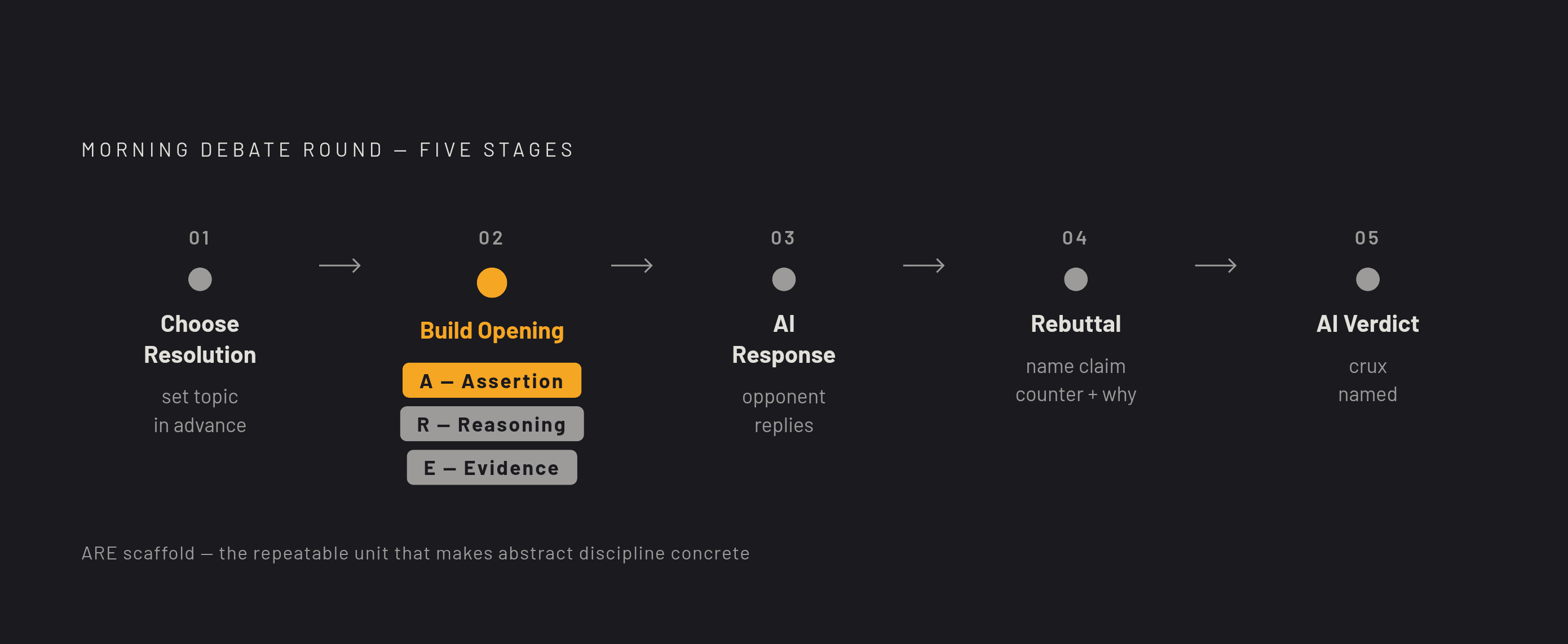
Setup must stay small enough that the round survives an unmotivated morning. Choose one resolution in advance, rather than spending the practice window deciding what to debate. Have the sides assigned. Use a solo AI opponent for the exchange and require a written judgment against a defined rubric.
The round itself needs only a short timed opening and a rebuttal turn before judgment. Build the opening with the ARE scaffold, using an assertion, key reasoning, and one or two pieces of evidence. The rebuttal should name the opposing claim, state the counter, and explain why it holds. Keep preparation minimal by design, because the exercise is meant to practice finding connections under constraint.
The debrief deserves the same attention as the speeches. After reading the verdict, ask where the round turned and examine the argument the judge named as the crux. That keeps review focused on reasoning rather than the satisfaction or disappointment of the result. Switching between everyday-life motions, work and school resolutions, and technology-policy questions also keeps knowledge of a familiar subject from doing all the work. Framing and Steel Man practice should remain demanding.
The record to retain is the written decision and its named turning point. A month of morning rounds then leaves more than a tally of wins and losses. It leaves a log of cruxes, showing where a premise needed support, where a rebuttal failed to connect, or where an argument survived its strongest challenge. That is a more exact account of reasoning than an unstructured journal can provide, because each entry records a position tested against opposition.
Sources
- Conch: Competitive Debate Analysis via Visualizing Clash Points and Hierarchical Strategies
- Benchmarking LLM Judges via Debate Speech Evaluation
- Argumentation, leadership, and curriculum
- From Generation to Judgment: Opportunities and Challenges of LLM-as-a-judge
- Benchmarking LLM-as-a-Judge for Long-Form Output Evaluation
- From Holistic Evaluation to Structured Criteria: Rubrics Across the Evolving LLM Landscape