Choosing an AI Debate App by the Quality of Its Counterarguments Not Its Interface
Pick a solo AI debate opponent for its counterarguments, not its polish.
For daily debate practice without a partner, choose a solo AI debate opponent by the strength of its counterarguments. The useful test is whether it can steel-man your position, sustain an opposing argument under pressure, and explain where your reasoning failed. DebateAI offers direct you-vs-AI practice, while ContradictMe focuses on steel-manned challenges with evidence-quality signals.
Why interface quality is the wrong thing to optimize for in an AI debate tool
An app store screenshot or slick onboarding makes a debate tool easy to assess before its arguments have been tested. Speed, polish, and low friction are immediately visible. The time needed to assess adversarial quality encourages buyers to select the experience they can judge quickly over the opposition that will improve their reasoning. The AI must be able to make them lose an argument they thought was airtight.
A clean interface is useful, but it does not establish that the opponent is trying to win. Feeling heard is not the same as being challenged. A system can acknowledge a position, produce an orderly response, and leave its central warrant untouched. If that keeps happening, weeks of daily practice may mean facing agreeable opposition over and over with little pressure to defend an argument.
What a genuinely adversarial counterargument requires the AI to do
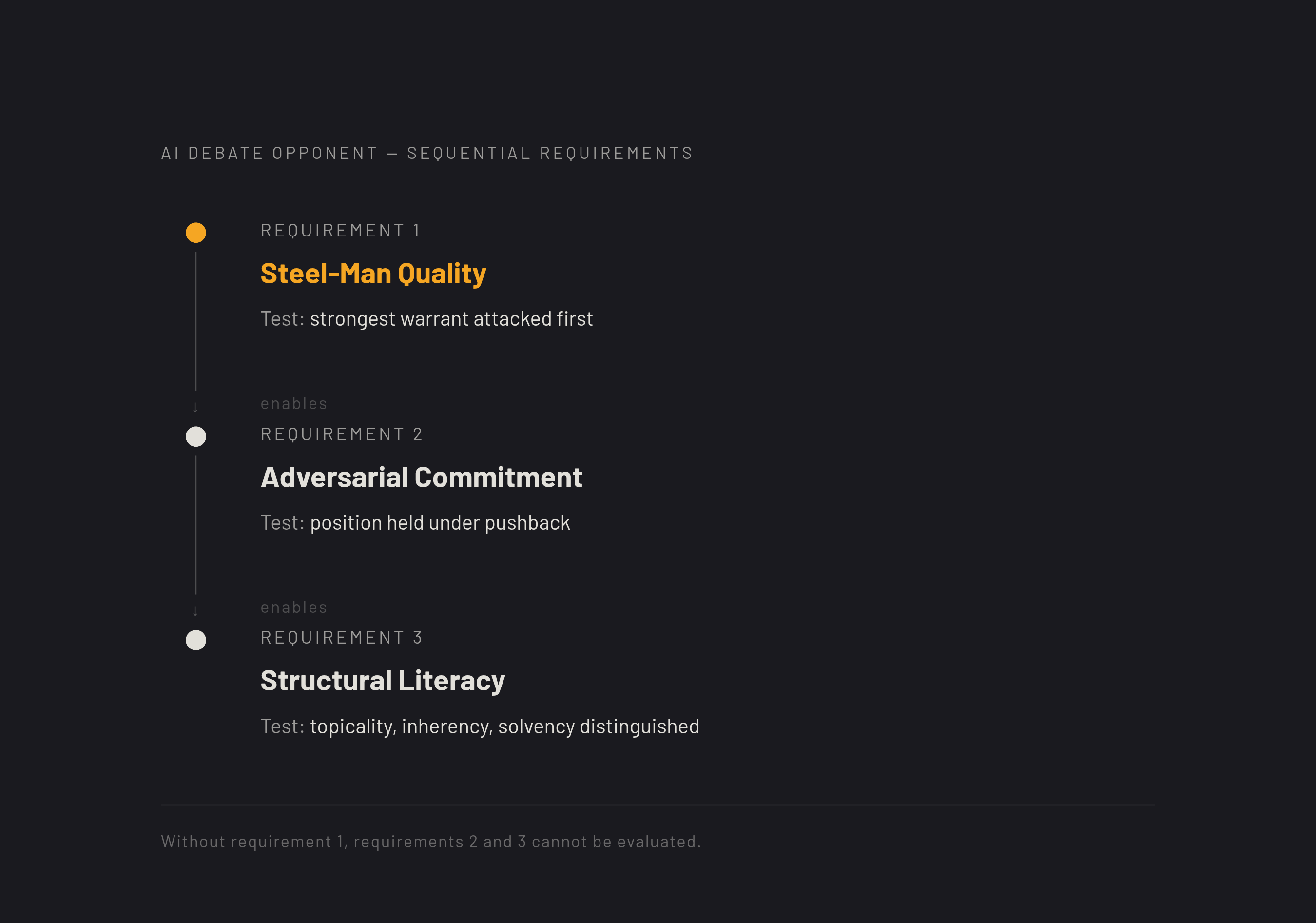
Steel-man quality is the first requirement because a counterargument is only as strong as its account of the position it attacks. The AI must present the strongest, most internally coherent version of that position before attempting a refutation. Charity makes the disagreement more exact. The practical test is whether the response identifies the best warrant connecting your evidence to your conclusion and attacks that warrant specifically.
ContradictMe’s design principles give this requirement a concrete form. The system is built to present strong counterarguments, cite research with quality scores, flag limitations and mixed evidence, and avoid attacking the person. Those distinctions separate evidential pressure from rhetorical aggression. A response can sound forceful while relying on weak support. Conversely, a counterargument that acknowledges uncertainty can be harder to answer because it does not claim more than its evidence supports.
Adversarial commitment is the second requirement, and it becomes visible only after pushback. An opening objection is not enough by itself. The AI must hold its opposing position rather than soften it or validate your rebuttal merely to satisfy you. This requires acknowledging a successful refutation while keeping the disagreement alive where the underlying warrant remains intact, even when you express confidence.
Structural literacy is the third requirement because different objections impose different burdens. Topicality concerns whether a proposal falls within the debate’s scope, and winning that challenge can end a round regardless of substantive strength. Inherency concerns whether barriers in the status quo prevent the problem from being solved without the proposed change. Solvency asks whether the plan will actually tackle the harm. These are not interchangeable objections. Showing that existing arrangements are already making progress attacks inherency, while showing that a proposal will not work attacks solvency, even if the harm occurs.
The single-model problem that most AI debate apps share
Most AI debate apps use the same model to write both sides. When the same system generates Position A and Position B, their arguments arise from shared assumptions. The result may be coherent precisely because the opposition anticipates the original argument. Coherence alone does not demonstrate genuine adversarial pressure.
Apol illustrates how persona differences can obscure that shared foundation. Its “Cartesian rationalist” and “pragmatic populist” have different rhetorical styles, but the argument substance comes from the same model. Style can make the speakers feel distinct. It does not establish that they approach the question with different priors, training data, or blind spots. The relevant distinction is between two ways of presenting an argument and two genuinely different sources of disagreement.
A single model can still expose a weak argument by generating an objection the user has not encountered. That benefit should not be dismissed. Direct practice against an AI opponent and watching independent models disagree are different uses, however, and success at one does not establish success at the other. Even two models built by the same company and fine-tuned on overlapping corpora do not, merely by being separate models, establish independent perspectives. Model count and persona count are therefore insufficient substitutes for inspecting the arguments.
Do the opposing positions disagree about a warrant, or do they simply express familiar objections in different voices? That distinction makes the structural diagnosis testable. A shared-model exchange may still be useful for rehearsal, but its apparent range should not be confused with the range of opponents a debater may face.
How do the available tools differ for solo AI debate practice?
DebateAI offers a participant model for training alone. You pick a topic, state your position, and the AI argues the other side. Built on Claude, it is tuned to hold that opposing position rather than slip into the agreeableness associated with general assistants. It also tracks the thread across rounds and scores performance. Its free tier needs no account, so a prospective user can test its adversarial commitment before signing up.
That design addresses one part of the three-part test directly, but its other parts still require scrutiny. Holding a position is not enough on its own. The counterargument must also engage the strongest warrant, and the score must reflect the structure of the exchange.
MasterDebater uses a single model with character personas and is entertainment-first. Its relevant use here is practice against an AI opponent, rather than observing genuine disagreement between independent models. Different characters may change how the opposing case sounds, but they still draw on a single model. The same steel-man and persistence tests apply regardless of how distinctive a character sounds.
ContradictMe takes a belief and gives back a steel-manned counterargument with quality scores for each argument, source credibility badges, clear limitations, and follow-up questions. For retrieval, it ranks results by quality score ahead of how relevant they are. That choice places evidence assessment inside the challenge itself. It also offers a two-agent debate arena with Logical Larry and Emotional Emma across five structured rounds. As a DEV Challenge submission, it should not be treated as a commercial product at the same scale as the other tools.
Gemini has a different role in this comparison as a general chatbot useful for pulling in real-time context when a proposition concerns recent events. An up-to-date answer can still sidestep the strongest opposing warrant or give in too easily under pushback. For someone choosing a tool to argue both sides while training alone, these distinctions are more useful than a single overall ranking.
What the topic the AI debates you on reveals about its counterargument depth
To test any tool before committing, use a topic whose strongest objection calls for knowledge of how an argument works beyond familiar talking points. The purpose is to find the crux. A weak response names a concern without explaining how it defeats the position, while a strong response identifies the mechanism that connects the concern to the disputed conclusion. The same topic can then test both steel-man quality and adversarial commitment as the exchange continues.
AI in hiring provides a clear diagnostic. A weak counterargument says only that AI can be biased. A stronger one explains how AI can launder bias when a model trained on a company’s past hires inherits prejudice in that history and presents it under a look of objectivity. The objection concerns more than an inaccurate decision. It concerns a form of bias that becomes structurally harder to challenge than a human interviewer’s bias. A response that stops at the generic warning has not reached that warrant.
Remote work tests whether the AI can tell different kinds of results apart. A weak pro-remote response merely asserts that people are productive at home, while a strong one engages what large-scale output studies actually found. The opposing case has a different burden. Its strongest form concerns collaboration, mentorship, and organizational culture degrading, rather than simply assuming that remote employees produce less. An AI that answers a collaboration objection only with a productivity claim has not resolved the disagreement.
Crypto regulation tests a similar distinction between burdens. The innovation objection asks whether treating everything the same way keeps legitimate new frameworks from taking shape, while the investor-protection argument points to how much retail investors lose in unregulated markets. Neither automatically disposes of the other. A weak response collapses the exchange into being for or against regulation. A stronger response explains which concern a proposed position addresses and which objection remains unanswered, without pretending that evidence for one burden settles both.
Topics from students’ own lives offer another way to test inherency. Right to repair, phone bans in schools, AI on homework, and social media age limits can all expose whether the AI goes beyond surface-level advantages and disadvantages. The key is what blocks change now. A substantive response asks whether existing arrangements can address the problem or whether a structural barrier makes the proposed change necessary. That analysis distinguishes a reason for concern from a reason to adopt a particular intervention.
How to evaluate the feedback a tool gives after the round ends
Post-round feedback should identify which warrants landed, which arguments were dropped, and which rebuttals attacked a conclusion while leaving its supporting link untouched. A verdict alone cannot do that work. Even strong opposition during the round loses some training value if the tool gives no explanation of why that opposition succeeded. Useful feedback must, at minimum, provide a breakdown that changes what the debater can do in the next round.
Debate Arena’s detailed evaluations on its paid plan separate logic, structure, evidence, impact, refutation, and persuasiveness. That separation makes the feedback more inspectable. An argument can be persuasive without being well supported, or well structured without answering the opponent’s central objection. The platform offers a free plan with unlimited debates against AI and live opponents, as well as a Gold paid plan.
ContradictMe places per-argument quality scores and flags for limitations and mixed evidence inside the exchange. Timing changes how feedback can support practice. Embedded feedback makes the claimed strength of an objection visible while the debater is still responding to it. A post-round explanation instead has to reconstruct which parts of the exchange determined the outcome. In either format, a score is useful only to the extent that its reasoning can be examined.
Self-preference introduces a further problem when an AI judges the exchange. If the judge consistently favors outputs from models with similar training over outputs from structurally different models, the result reflects model similarity. A tool’s willingness to let users probe or challenge judging decisions is therefore a quality signal. For daily solo practice, the decisive final question is whether the feedback explains a failure of reasoning clearly enough to make the next round different.